
Open WebUI
Self-hosted, extensible interface for running any local or cloud LLM, built for privacy-first teams and individuals.
Community:


Product Overview
What is Open WebUI?
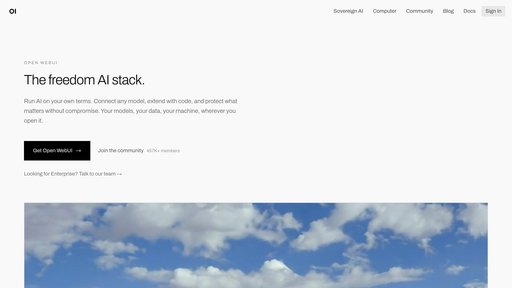
Open WebUI is a self-hosted platform that acts as a unified front-end for large language models, letting users connect to Ollama, OpenAI-compatible APIs, or Open Responses providers from one interface. Instead of juggling separate apps for chat, document search, image generation, and code execution, Open WebUI brings conversations, knowledge bases, tools, and models into a single workspace that can run entirely offline. It is designed for teams and individuals who want full control over their data, infrastructure, and model choices without depending on a single vendor.
Key Features
Multi-Provider Chat
Connect to Ollama, OpenAI, Anthropic, or any OpenAI-compatible API, and run multiple models side-by-side in the same conversation for comparison.
Knowledge & RAG
Build knowledge bases from uploaded documents using hybrid vector search, cross-encoder reranking, and multiple extraction engines like Tika and Docling.
Custom Agents & Model Presets
Wrap any base model with system prompts, bound tools, and knowledge sources to create specialized agents such as reviewers or summarizers.
Open Terminal
Give the AI access to a real or containerized computing environment where it can write, execute, and debug code directly from chat.
Extensibility via Tools & MCP
Extend functionality with Python tools, pipelines, OpenAPI servers, or native Model Context Protocol support to add custom capabilities.
Enterprise-Grade Access Control
Manage multi-user environments with role-based access, SSO/OIDC/LDAP integration, SCIM provisioning, and granular per-model permissions.
Use Cases
- Self-Hosted AI Deployment : Organizations run their own private AI stack on Docker, Kubernetes, or bare metal instead of relying on third-party cloud AI services.
- Team Knowledge Assistants : Teams upload internal documents and let the AI autonomously search and synthesize answers from a shared knowledge base.
- Developer Code Workflows : Developers use Open Terminal to have the AI write, run, and iterate on code within an isolated environment.
- Collaborative AI Channels : Teams tag different models into shared channels to draft, critique, and refine work together in real time.
- Custom Agent Building : Product and support teams create task-specific agents, like meeting summarizers or code reviewers, using bound tools and instructions.
FAQs
Open WebUI Alternatives

ChatWise
Knowledge monetization platform that transforms expertise into subscription-based chatbots for revenue generation.

Chaport
All-in-one customer messaging platform offering live chat, chatbots, multi-channel communication, and knowledge base integration.

LibreChat
Self-hosted chat platform for using multiple AI models, building agents, and connecting external tools.

ChatBot
AI-powered chatbot platform enabling businesses to automate customer service, lead generation, and internal workflows with customizable chatbots across multiple channels.

SiteGPT
AI-powered chatbot platform delivering personalized, content-driven customer support with seamless website integration and human escalation.

LiveChatAI
AI-powered chatbot platform leveraging GPT-4 technology to deliver personalized, accurate, and scalable customer support with seamless human handoff.

Chat Data
A highly customizable AI chatbot platform that enables creation and integration of chatbots using your own data, pre-trained models, or custom APIs.

SiteSpeakAI
AI-powered chatbot platform that automates customer interactions with custom-trained GPT chatbots.