
Lium
Collaborative AI platform for complex, real-world data that enables domain experts to query terabyte-scale datasets in natural language.

Product Overview
What is Lium?
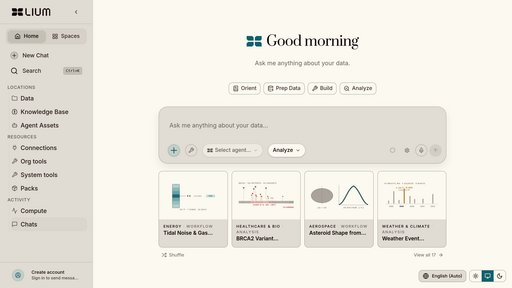
Lium is a collaborative AI platform designed for scientists, analysts, and domain experts working with complex, multimodal, and large-scale datasets. It connects diverse data sources including databases, files, APIs, and instrument outputs, then allows users to query and analyze this data through natural language conversations. The platform automatically indexes and profiles data, provisions compute on demand, and saves analyses as reusable artifacts for team collaboration.
Key Features
Universal Data Connectivity
Connects to databases, files, APIs, instrument outputs, and internal tools with automatic indexing and profiling so agents understand data structure without manual setup.
Natural Language Querying
Ask questions in plain English across connected datasets and receive reliable answers without requiring SQL, coding skills, or days of engineering work.
Knowledge Artifacts Library
Every analysis, script, chart, dataset, or tool is saved as a reusable artifact that teammates can re-run, share, or build upon.
On-Demand Compute Scaling
Automatically provisions compute resources for heavy tasks like scanning terabytes, with no DevOps overhead or cluster management required.
Multi-Domain Data Intelligence
Integrates geospatial, energy, space, subsurface, and infrastructure datasets into unified intelligence for specialized domains.
Collaborative Workspaces
Shared team workspaces enable multiple users to work on connected data simultaneously and build on each other's analyses.
Use Cases
- Enterprise Data Analysis : Analysts and data scientists can query complex, messy datasets across databases, files, and APIs to extract insights without writing code.
- Geospatial Intelligence : Combine satellite imagery, terrain models, and vector datasets into unified analysis for geospatial research and planning.
- Energy and Subsurface Research : Energy companies and geologists can analyze seismic surveys, subsurface data, and scientific measurements through natural language.
- Scientific Research : Researchers in space, climate, and lab sciences can process complex datasets and codify institutional knowledge into reusable workflows.
- Infrastructure and Engineering : Engineering teams can analyze infrastructure data, power grids, and technical measurements to accelerate decision-making.
FAQs
Lium Alternatives

Cofactr
A unified supply chain execution platform that streamlines procurement, inventory, and logistics for hardware manufacturers.

BlueCargo
AI-driven platform optimizing container management and demurrage & detention cost mitigation at seaport terminals.

Culture Biosciences
Cloud-connected bioreactor platform enabling remote design, monitoring, and analysis of cell culture experiments to accelerate bioprocess development.

Spartan Forge
Advanced hunting app combining high-resolution mapping, LiDAR terrain data, and predictive analytics for deer movement.

Logcomex.ai
Foreign trade platform with specialized AI agents for import/export data analysis, cargo tracking, HS code classification, and supplier prospecting via natural language commands.

Atmo
Ultra-precise weather intelligence platform combining global data and deep learning to deliver real-time, high-resolution forecasts for governments and industries.

Comand AI
AI-powered command and control software designed to enhance military decision-making with rapid planning, tactical simulations, and battlefield resilience.

Carbonfact
Sustainability management platform tailored for apparel and footwear brands to measure, report, and reduce their environmental footprint across the supply chain.