
Landing AI
Leading Visual AI platform enabling rapid creation, deployment, and scaling of deep-learning computer vision solutions with a data-centric approach.
Community:


Product Overview
What is Landing AI?
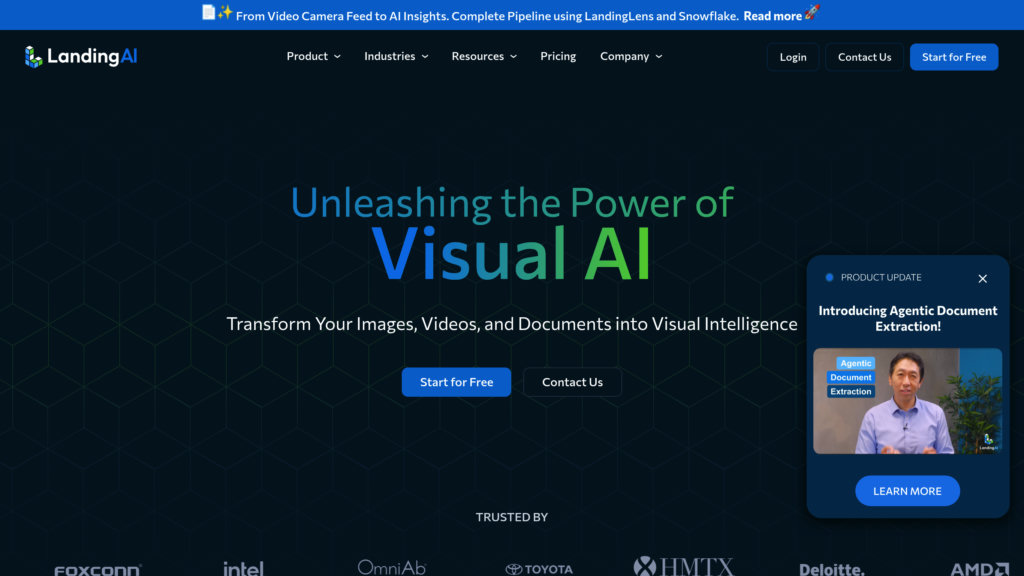
Landing AI, founded by AI pioneer Andrew Ng, specializes in visual AI solutions that transform industries by unlocking the value of visual data. Its flagship product, LandingLens, is a cloud-based computer vision platform designed for users with or without AI expertise to quickly build, train, and deploy deep-learning models for defect detection, classification, and segmentation. The platform emphasizes data quality and consistency through advanced labeling tools and a data-centric AI methodology, enabling companies to move AI projects from proof-of-concept to full-scale production. Landing AI supports flexible deployment options including cloud, edge devices, and integration with third-party platforms like Snowflake, making it scalable from single production lines to global operations.
Key Features
End-to-End Visual AI Workflow
Comprehensive platform covering image upload, annotation, model training, evaluation, and deployment in one seamless system.
Data-Centric AI Approach
Ensures high data quality and labeling consistency with tools like the Defect Book, collaborative labeling, and automatic detection of mislabeled data.
No-Code Model Building
Enables users without AI or programming expertise to create and improve computer vision models quickly using intuitive interfaces.
Flexible Deployment Options
Supports cloud deployment, edge device deployment via LandingEdge, and API integration for diverse operational environments.
Advanced Model Management
Includes features for custom training, hyperparameter tuning, error analysis, and performance monitoring to optimize model accuracy.
Scalable Collaboration and Operations
Facilitates multi-team collaboration and management of multiple projects across locations with standardized workflows.
Use Cases
- Automotive Quality Inspection : Automates defect detection in complex assemblies such as welds, coatings, and EV batteries to improve safety and yield.
- Healthcare and Pharmaceutical Inspection : Detects contaminants and defects in medical devices, vials, and cells ensuring compliance and patient safety.
- Manufacturing Defect Detection : Identifies subtle defects and assembly errors to reduce waste, improve process monitoring, and enhance production efficiency.
- Electronics Inspection : Inspects wafers, PCBs, and solder joints with precision to maintain high-quality standards in electronics manufacturing.
- Agricultural Automation : Supports automated picking, disease classification, and product grading to optimize crop yield and operational efficiency.
FAQs
Landing AI Alternatives

Datature
An all-in-one platform that streamlines the entire computer vision workflow from dataset management and annotation to model training and deployment without requiring coding skills.

Segments.ai
Multi-sensor data labeling platform enabling efficient annotation and management of 2D and 3D datasets for robotics and autonomous systems.

FlyPix AI
AI-powered geospatial analytics platform specializing in object detection, change tracking, and anomaly identification from satellite and aerial imagery.

Playment
A fully managed data labeling platform delivering high-quality annotated datasets for training and validating computer vision models at scale.

Intelgic
Comprehensive machine vision and automation platform delivering precise defect detection, SOP monitoring, and product counting for manufacturing quality control.

Azure AI Custom Vision
A flexible computer vision service that enables users to build, train, and deploy custom image classification and object detection models tailored to specific needs.

Picterra
Cloud-native platform for building, deploying, and managing scalable geospatial machine learning models with streamlined workflows and minimal data requirements.

CVAT
Industry-leading data annotation platform for machine learning, enabling teams to annotate images and videos with multiple annotation types and cloud-based storage.