
GitAgent
An open standard for defining, versioning, and running AI agents natively in Git — portable across any framework, runtime, or model.
Community:


Product Overview
What is GitAgent?
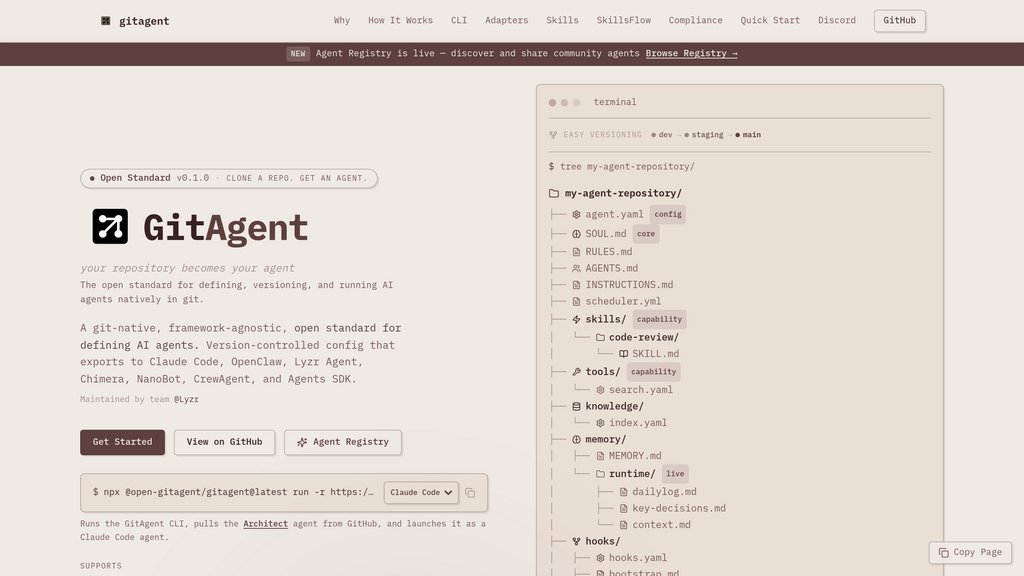
GitAgent is a git-native, framework-agnostic open standard that packages an AI agent's config, logic, tools, memory, and skills as plain files inside a Git repository. Maintained by Lyzr, it lets developers define an agent once and deploy it to any supported runtime — Claude Code, OpenAI Agents SDK, CrewAI, Google ADK, LangChain, and more — with a single command. By treating the repository as the agent itself, GitAgent brings familiar developer workflows like branching, pull requests, versioning, and CI/CD to the full lifecycle of AI agents.
Key Features
Git-Native Agent Definition
Agents are defined as versioned files (agent.yaml, SOUL.md, SKILL.md) inside a repo, enabling full commit history, rollbacks, branching, and audit trails for all agent behavior changes.
Framework-Agnostic Portability
Export the same agent definition to Claude Code, OpenAI Agents SDK, CrewAI, Google ADK, LangChain, Lyzr Studio, and GitHub Models without rewriting logic for each platform.
SkillsFlow Workflows
Define deterministic multi-step agent pipelines in YAML, chaining skill, agent, and tool steps with dependency ordering and template-based data flow.
CI/CD & Human-in-the-Loop
Run gitagent validate in GitHub Actions on every push; use branch and PR review workflows to gate agent skill updates with human approval before merging.
Compliance & Audit Support
Built-in regulatory mapping for FINRA, SEC, Federal Reserve, and CFPB, with Segregation of Duties conflict matrices and full audit reports via gitagent audit.
Agent Registry & Reusable Skills
Browse, clone, and share community agents at registry.gitagent.sh; discover reusable skill packages through the SkillsMP marketplace.
Use Cases
- Cross-Framework Agent Migration : Teams switching from one agent framework to another can export the same definition rather than rebuilding agent logic from scratch.
- Automated Code Review Agents : Define a PR review agent with versioned instructions and tooling inside the target repo itself, updating review logic through standard pull requests.
- Enterprise Compliance Workflows : Financial and regulated organizations can enforce audit trails, SOD policies, and regulatory mappings across deployed agents using built-in compliance tooling.
- Multi-Environment Agent Deployment : Use git branching (dev → staging → main) to promote and test agent behavior across environments with the same workflows used for application code.
- Community Agent Sharing : Developers can fork public agents from the registry, customize identity and skills, and contribute improvements back upstream via pull requests.
FAQs
GitAgent Alternatives

Inferable
Open-source developer platform for building secure, reliable, and distributed LLM-powered AI agents with on-premise execution and multi-language SDKs.

AgentBox
Dedicated email service that gives AI agents their own mailboxes for seamless collaboration and communication via standard IMAP/SMTP protocols.

smolagents
Minimalist AI agent framework enabling efficient, secure code-based agents powered by any large language model with deep Hugging Face Hub integration.

Reflexio
Continuous learning layer that enables software agents to adapt and self-improve from real interactions without model retraining.

CloudX
Supply-side platform for mobile and AI publishers with agent-driven monetization workflows and transparent auction infrastructure.

Dedalus Labs
A flexible platform providing a unified API to connect any large language model (LLM) with any managed MCP (Model-Controller-Platform) server, enabling rapid deployment of AI agents.

Swytchcode
An execution layer for API integrations that sits between AI agents and production, handling auth, retries, schema validation, and policy control across 2000+ APIs via a single CLI.

Klavis AI
Open-source MCP integration platform providing hosted servers and multi-platform clients for seamless AI application development.