
Fabraix
Adversarial verification platform for AI agents, combining offensive attack simulation and runtime defense to identify and block agent vulnerabilities before they are exploited.
Community:

Product Overview
What is Fabraix?
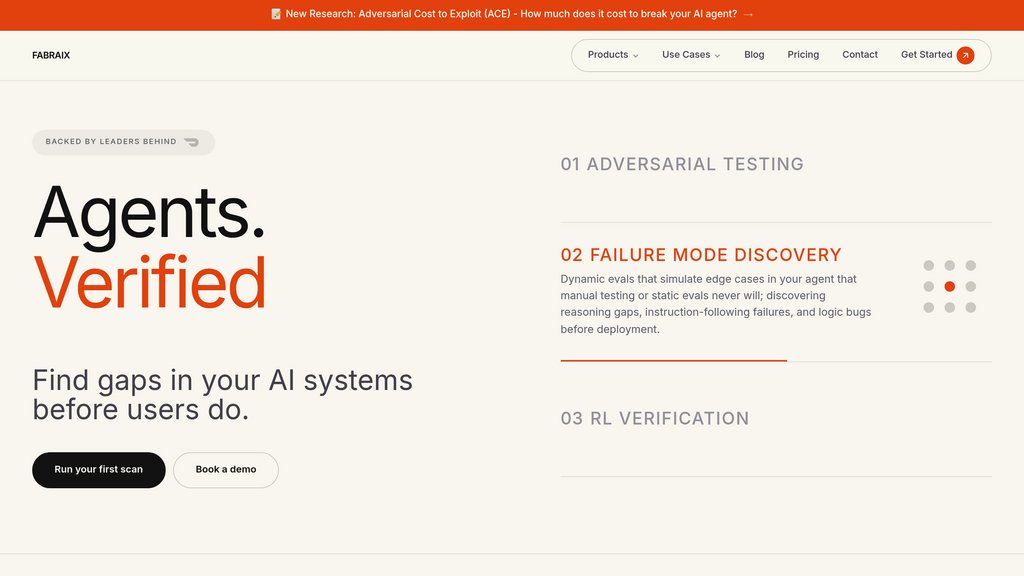
Fabraix is an AI security research lab that builds tooling for offensive verification and runtime defense of AI agents. Its two core products — Nyx and Arx — work in tandem: Nyx autonomously probes agent systems using multi-turn, blackbox adversarial strategies, surfacing real exploits; while Arx translates those findings into runtime guardrails that actively block threats. Fabraix's approach is grounded in original research, including the Adversarial Cost to Exploit (ACE) framework, which reframes AI security from binary pass/fail outcomes into measurable, deployable economics.
Key Features
Autonomous Offensive Agent (Nyx)
Nyx probes AI agent systems autonomously using multi-turn, pure blackbox adversarial strategies — adapting in real time to surface exploits that manual red-teaming would miss.
Runtime Defense Layer (Arx)
Arx registers agent sessions, logs events, and performs in-context action checks to block prompt injection, goal deviation, and memory poisoning at runtime — informed directly by what Nyx discovers.
Adversarial Cost to Exploit (ACE)
A proprietary research framework that quantifies AI security risk in economic terms, enabling teams to prioritize defenses based on exploit cost rather than abstract severity scores.
Scalable Adversarial Coverage
Thousands of adversarial strategies run concurrently, meaning coverage scales with compute rather than headcount — making comprehensive security audits accessible without large red-team staffing.
Adversarial Playground
An interactive environment for testing prompt injection resilience against AI agents, useful for both security research and developer education.
Use Cases
- AI Agent Security Auditing : Security teams can deploy Nyx to run automated adversarial scans against production or staging AI agents, receiving detailed exploit reports without manual red-teaming.
- Runtime Threat Prevention : Engineering teams instrument their agent pipelines with Arx to monitor and block live attacks — including prompt injection and memory poisoning — as agents operate in production.
- AI Risk Quantification : CISOs and risk officers can use the ACE framework to translate AI agent vulnerabilities into cost-based metrics, making security investment decisions more defensible.
- Developer Security Testing : Developers building LLM-based applications can use the Fabraix Playground to stress-test their prompts and agent designs against adversarial inputs before deployment.
- Compliance & Threat Intelligence : Organizations operating regulated AI systems can leverage Fabraix's continuously surfaced exploit findings as ongoing threat intelligence to support audit and compliance workflows.
FAQs
Fabraix Alternatives

Prefactor
Agent observability and evaluation platform that monitors production AI agents for quality, risk, and cost, with runtime controls to enforce policy.

Athina AI
Collaborative AI development platform enabling teams to rapidly prototype, test, monitor, and deploy production-grade LLM applications with robust observability, analytics, and privacy controls.

Relyable
Comprehensive testing and monitoring platform for AI voice agents, enabling rapid deployment and production reliability through automated evaluation and real-time performance tracking.

Decipher AI
AI-powered session replay analysis platform that automatically detects bugs, UX issues, and user behavior insights with rich technical context.

fixa
Open-source Python package for automated testing, evaluation, and observability of AI voice agents.

MAIHEM.ai
Enterprise-grade AI quality control platform offering automated testing, monitoring, and red-teaming for AI workflows at scale.

Vocera AI
AI-driven platform for testing, simulating, and monitoring voice AI agents to ensure reliable and compliant conversational experiences.

Zipy
AI-powered user behavior and product analytics platform combining real-time monitoring, session replay, and advanced debugging for seamless user experience optimization.