
Cua
Infrastructure for running, training, and evaluating computer-use agents across Linux, Windows, macOS, and Android.
Community:


Product Overview
What is Cua?
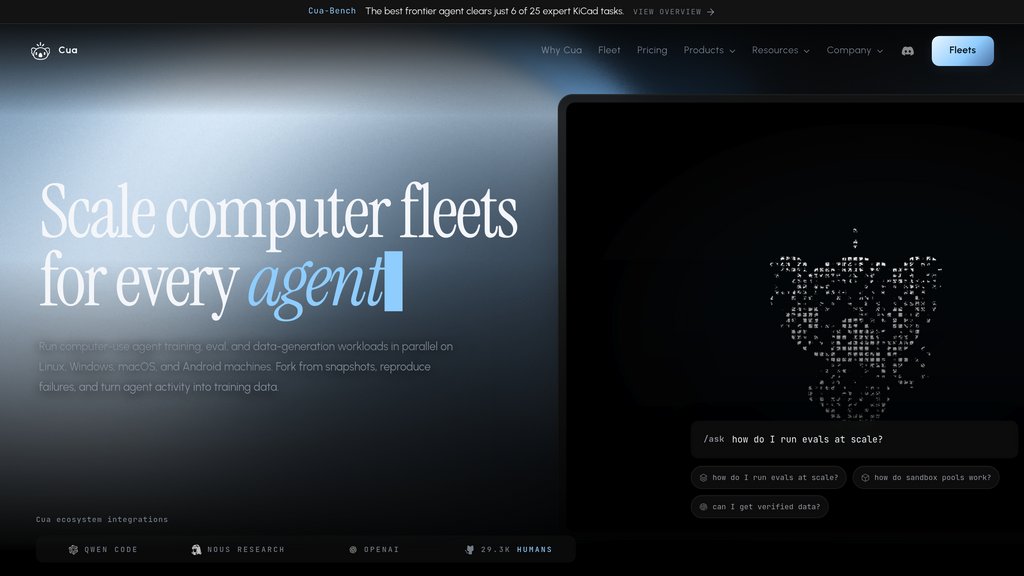
Cua provides desktop environments and fleet infrastructure for computer-use agents. Developers can provision local or cloud sandboxes, automate application interactions, and scale workloads across multiple operating systems. Its ecosystem combines desktop control, environment management, benchmarking, and verified trajectory data to support agent development, evaluation, and training.
Key Features
Cross-Platform Sandboxes
Provision disposable Linux, Windows, macOS, and Android environments through a unified API for local or cloud workloads.
Background Desktop Control
Control native desktop applications through clicks, typing, scrolling, and accessibility inspection without taking over the user's cursor or focus.
Elastic Computer Fleets
Scale parallel workloads with pre-booted machine pools that provide fast allocation and scale to zero when idle.
Reproducible Agent Runs
Fork environments from snapshots and reproduce failures to investigate agent behavior and compare results.
Verified Training Data
Generate or obtain verified task trajectories, with human-reviewed examples and step-level annotations available for selected scopes.
Developer Integrations
Connect desktop control through MCP or CLI, provision sandboxes through Python, and use open-source components within existing agent stacks.
Use Cases
- Agent Training : Run parallel interactions with real desktop environments to support reinforcement learning and improve computer-use capabilities.
- Cross-Platform Evaluation : Benchmark agents across operating systems and application workflows using task evaluators to check completion.
- Training Dataset Production : Collect verified interaction trajectories for model training or consume datasets produced by Cua's managed infrastructure.
- Desktop Workflow Automation : Build agents that operate browsers, native applications, and legacy software through their graphical interfaces.
- Failure Investigation : Recreate unsuccessful runs from environment snapshots to diagnose errors and test changes under repeatable conditions.
FAQs
Cua Alternatives

Orgo
Cloud desktop infrastructure for autonomous agents — spin up full virtual machines that models like Claude, GPT, and Gemini can see and control.

Google Antigravity
Agent-first development platform enabling autonomous AI agents to independently plan, code, test, and validate complex software projects across editor, terminal, and browser.

Qoder
Qoder is an advanced coding platform designed to autonomously handle real software development tasks by combining enhanced context engineering with intelligent agent technology.

Devin AI
Autonomous AI software engineer platform that plans, develops, tests, and deploys complex software tasks with minimal human intervention.

omp
Terminal-first coding agent combining code intelligence, live debugging, parallel subagents, and flexible model access.

OpenHands
Open-source platform for autonomous software development agents that execute coding tasks through natural language commands.

E2B
Open-source runtime enabling secure, scalable code execution in isolated cloud sandboxes for AI applications.

Maxim AI
End-to-end AI evaluation and observability platform accelerating reliable AI agent development and deployment.