
agent-browser
A headless browser automation CLI built for AI agents, delivering compact text output and fast command execution via a native Rust architecture.
Community:


Product Overview
What is agent-browser?
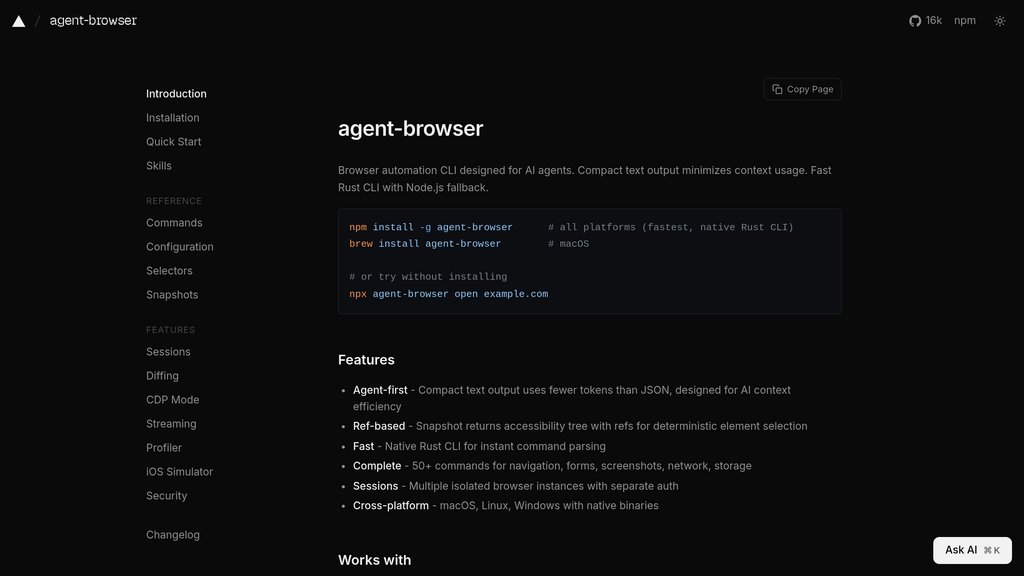
agent-browser is a browser automation command-line tool purpose-built for AI agents and the coding assistants they run inside — including Claude Code, Cursor, GitHub Copilot, OpenAI Codex, and Google Gemini. It outputs a compact accessibility tree instead of raw HTML or JSON, drastically reducing token consumption while giving agents deterministic control over web pages through a ref-based element selection system. The tool is built on a client-daemon architecture: a native Rust CLI handles command parsing at near-instant speed, while a persistent Node.js daemon manages the underlying Playwright browser instance. With 50+ commands covering navigation, form interaction, screenshots, network inspection, and storage, agent-browser provides full-cycle browser control optimized for automated agent workflows across macOS, Linux, and Windows.
Key Features
Ref-Based Element Selection
Snapshot command returns a compact accessibility tree where every element carries a unique ref (e.g. @e1), enabling deterministic, re-query-free interaction without ambiguity.
Token-Efficient Output
Text-based accessibility tree output uses roughly 200–400 tokens per snapshot, compared to 3,000–5,000 tokens for full DOM output, keeping agent context windows lean.
Native Rust CLI Performance
Command parsing is handled by a native Rust binary that starts instantly, with a persistent Node.js daemon managing the Playwright browser instance in the background.
50+ Browser Commands
Comprehensive command set covering page navigation, form filling, clicking, screenshots, network monitoring, and storage management for end-to-end browser control.
Multi-Session Support
Run multiple isolated browser instances simultaneously, each with independent authentication state, enabling parallel agent tasks or multi-account workflows.
Cross-Platform Compatibility
Native binaries available for macOS (ARM64 and x64), Linux (ARM64 and x64), and Windows (x64), with an npm fallback ensuring broad environment coverage.
Use Cases
- AI Coding Assistants : Agents inside Claude Code, Cursor, or GitHub Copilot can browse documentation, test web UIs, and fill forms as part of automated coding and debugging workflows.
- Web Scraping & Data Extraction : AI agents can navigate pages, capture snapshots, and extract structured information from websites with minimal token overhead per operation.
- Automated UI Testing : QA agents can script full browser interaction sequences — clicks, form submissions, screenshot comparisons — using deterministic refs rather than fragile CSS selectors.
- Multi-Step Web Automation : Complex workflows such as logging into services, filling multi-page forms, or monitoring network requests can be orchestrated through shell-command sequences any agent can issue.
FAQs
agent-browser Alternatives

Devin AI
Autonomous AI software engineer platform that plans, develops, tests, and deploys complex software tasks with minimal human intervention.

BrowserStack
Cloud-based platform providing instant access to thousands of real browsers and devices for comprehensive web and mobile app testing.

TestMu AI
Full-stack agentic quality engineering platform that autonomously plans, authors, executes, and analyzes tests across web, mobile, and AI applications.

BetterBugs
A Chrome extension that streamlines bug reporting by creating detailed, visual reports enriched with technical data and AI-assisted debugging.

Jam
One-click bug reporting tool that auto-captures all technical data developers need to debug faster with instant replay and seamless integrations.

Browserbase
Scalable headless browser infrastructure platform for web automation, testing, and data collection.

Browserless
Cloud-based headless browser automation platform enabling scalable, stealthy web scraping and automation with Puppeteer and Playwright support.

Katalon
All-in-one AI-augmented test automation platform supporting web, mobile, API, and desktop testing with rich integrations and scalable execution.