
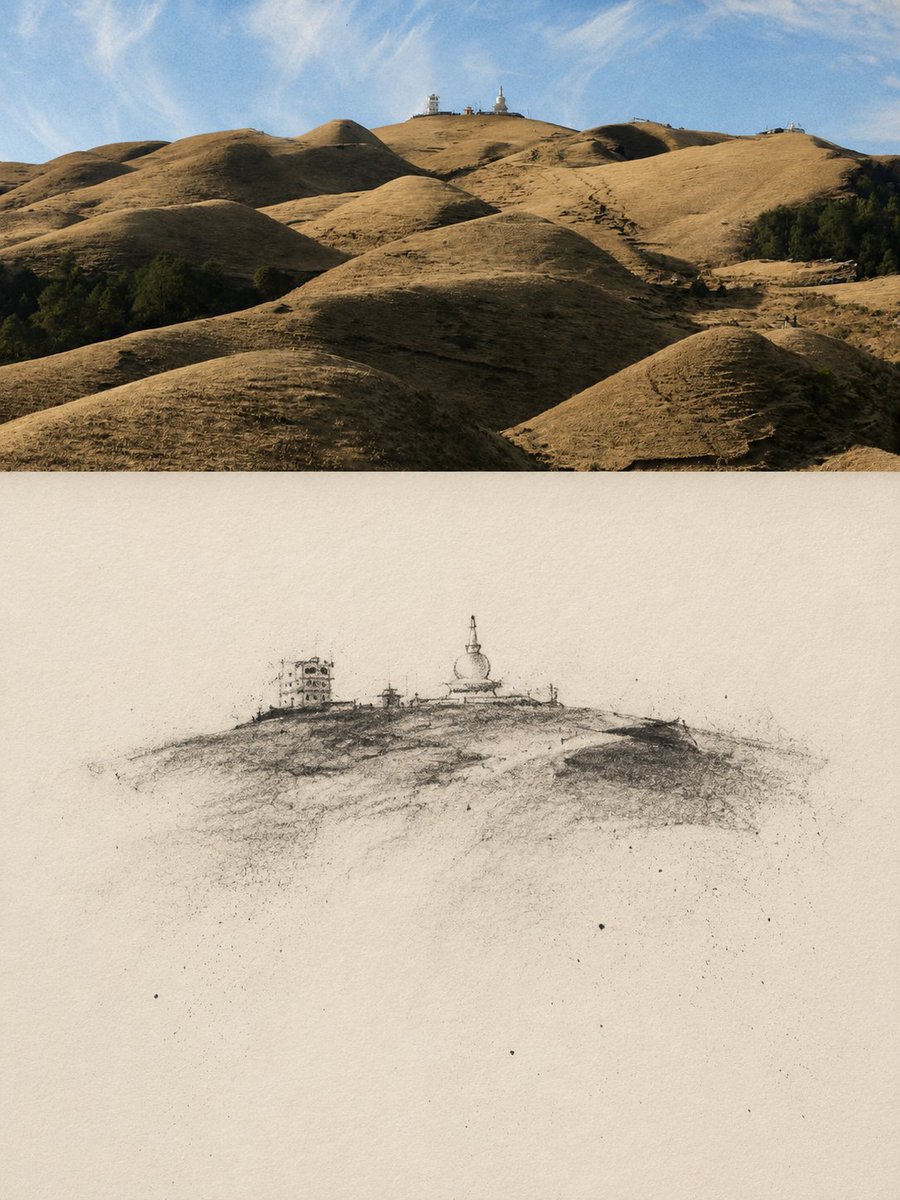
CHARCOAL VANISHING TRAVEL STUDY|Charcoal Vanishing Travel Sketch Create one separate advanced comparative poster for each travel photo I upload. Each uploaded photo must produce one individual output only. Never combine different photos, create a collage, or mix subjects from multiple images. The most important rule: preserve the uploaded photograph exactly as the visual source. The people, animals, buildings, vehicles, landscape, proportions, poses, positions, movement direction, perspective, lighting, textures, and overall identity must remain faithful to the original. Do not redesign, replace, beautify, reinterpret, or invent the main subject. Use a 3:4 vertical composition divided naturally into two distinct visual areas. The upper section contains the authentic photograph and the lower section contains a restrained charcoal memory sketch. The division should feel clean and intentional but not like a rigid graphic template. Aim roughly for 50% photograph / 50% charcoal paper, allowing the proportions to shift slightly when needed to preserve the original image naturally. TOP — AUTHENTIC TRAVEL PHOTOGRAPH Keep the uploaded photograph clearly recognizable as the actual original photo, not a realistic redraw. Preserve: - exact subject identity and quantity - original pose and body position - direction of movement - architecture and structural outlines - terrain and spatial relationships - natural perspective - authentic light and shadow - original textures and materials - original color atmosphere Only apply a very subtle editorial photographic treatment, similar to a refined travel magazine or art photography publication. Keep colors natural and restrained. Add only extremely subtle film grain. If the photograph needs to fit the 3:4 vertical format, use natural cropping or gentle environmental extension of surrounding sky, ground, mountains, or empty space. Never stretch, distort, relocate, replace, or redesign the actual subject. BOTTOM — VANISHING CHARCOAL MEMORY SKETCH Study the uploaded photograph first and identify the one or few visual elements that carry the strongest memory of the journey. Possible anchors include: a house, cable car, person, animal, vehicle, boat, bridge, tree, staircase, rock formation, doorway, architectural feature, or another clearly recognizable object. Do not turn the whole photograph into a charcoal landscape. Instead, reduce the most memorable subject into a loose, isolated charcoal study on warm white paper. Keep only enough of the surrounding environment to preserve the subject's identity, scale, direction, and sense of place. The charcoal subject should normally occupy only 18%–35% of the lower paper area, leaving generous untouched paper around it. The surrounding environment should be extremely minimal, with no complete background. At most include 1–3 quiet environmental traces, such as: - a broken ground line - a small rock or hillside fragment - two or three mountain strokes - a cable line - a few tree marks - a small cast-shadow indication - several short spatial smudges Everything else should disappear into untouched paper. CHARCOAL DRAWING LANGUAGE Make the sketch feel like a real unfinished travel sketch made by hand, not a digital filter. Use a restrained combination of: - willow charcoal - compressed charcoal - charcoal pencil - very light graphite - broad directional marks - short broken strokes - finger-smudged gray - kneaded-eraser lifting - charcoal dust - loose crumbs - visible paper tooth - uneven hand pressure - broken contours - dry powder residue Use broad and short directional marks to describe the subject's weight and structure. Avoid dense academic hatching and overly detailed pencil rendering. Reserve the darkest charcoal only for the most important identifying structures, such as: doorways, deep shadows, windows, tires, figure silhouettes, animal horns, structural joints, cable-car supports, boat undersides, or other essential anchor points. Use only one or two restrained smudged gray areas to suggest volume. Let the paper remain visible through the drawing. VANISHING EFFECT The disappearing quality must look physically drawn and partially erased, never digitally faded. The visual progression should feel like: clear charcoal structure → broken contour → loose smudge → scattered charcoal dust → untouched paper The edges should gradually lose definition because the artist stopped drawing, rubbed away the charcoal, lifted marks with an eraser, or simply left sections unfinished. Do not use: digital opacity, blur, glow, mist, airbrush, feathered masks, soft-focus effects, artificial gradients, or atmospheric digital fading. The subject should feel as though it is emerging from memory and quietly disappearing back into the paper. PAPER & COLOR The entire lower section must remain strictly monochrome. Use only: - warm white paper - warm gray - cool gray - charcoal black - very subtle graphite silver-gray Do not carry photographic colors into the sketch. The paper should feel authentic and tactile: matte warm-white drawing paper with visible tooth, subtle fibers, charcoal friction, powder residue, eraser marks, and natural imperfections. COMPOSITION & FEELING The final poster should resemble a preserved page from a high-end travel observation book or museum sketchbook. The photograph represents what was actually seen. The charcoal drawing represents what remained in memory. Keep the entire composition: quiet, restrained, spacious, tactile, imperfect, solitary, editorial, archival, and emotionally subtle. The contrast between the precise photograph and the unfinished charcoal memory should be the main visual idea. Do not make the charcoal subject oversized. Do not fill the lower half. Let the empty paper become an important part of the composition. STRICTLY AVOID No collage No multi-photo composition No complete charcoal landscape No full-background charcoal drawing No black-and-white filter over the original photograph No photo-realistic pencil redraw No dense hatching No academic illustration style No watercolor No ink wash No oil-painting effect No digital airbrushing No misty disappearance No artificial blur No smooth gradient fading No decorative borders No rigid graphic template No oversized subject No unnecessary objects No invented scenery No altered people or animals No changed architecture No subject replacement No logos No watermark No captions No numbers No explanatory text Final priority: the uploaded photograph must remain visually authentic and immediately recognizable. The charcoal section may interpret the photograph artistically, but it must preserve the same key subject, identity, pose, proportions, and visual memory rather than inventing a different scene.