
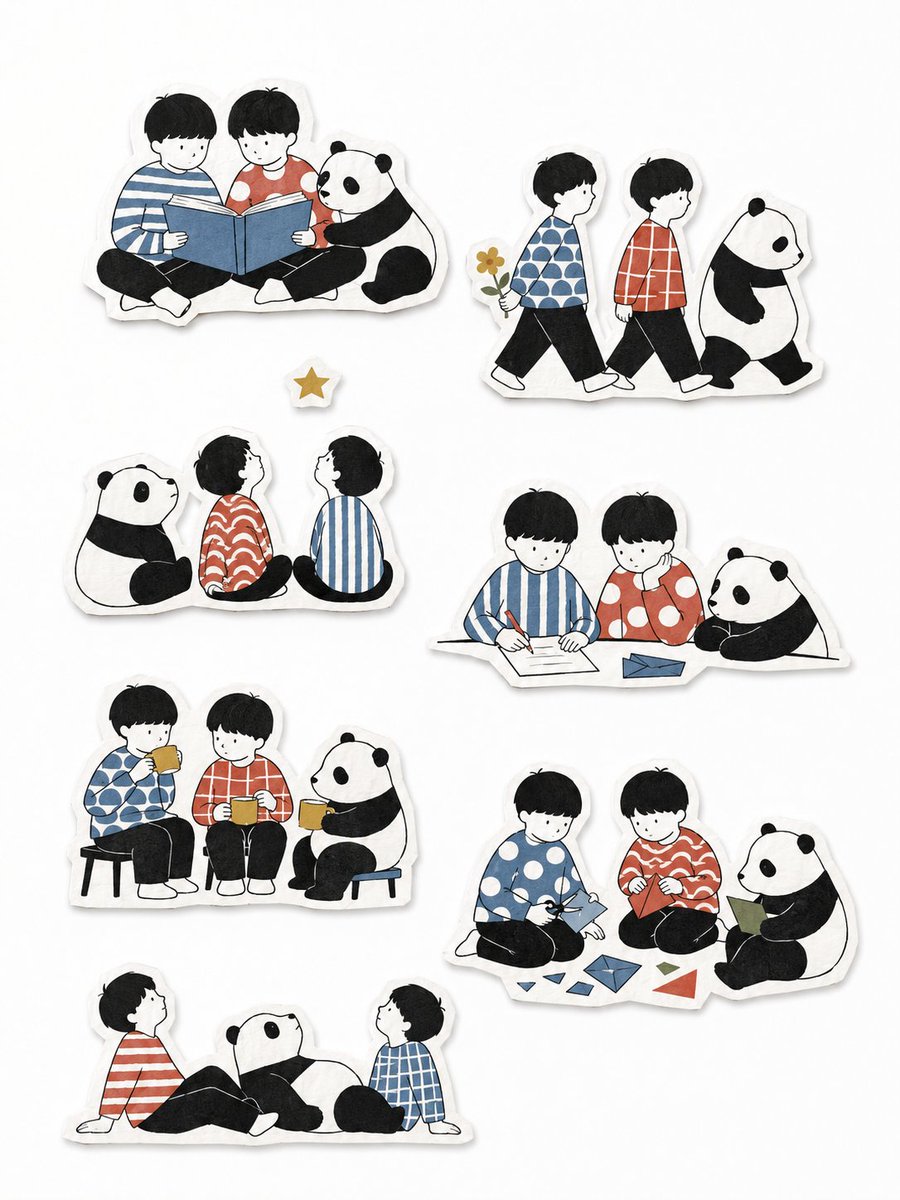
【THEME】 {Twin boys and a panda} You are a top-tier art director, editorial illustrator, paper-craft artist, and collage artist. Based on the theme above, generate a minimalist, refined work of "black-line illustration × flat color × paper cut-outs × patterned-paper collage" on a vertical 3:4 white canvas. Infer characters, clothing, actions, scenes, props, and colors naturally from the theme. However, if the theme text specifies a person, animal, age, clothing, prop, color, mood, or action, give that top priority. For unspecified elements, design them naturally on the AI side so they suit the theme and remain elegant and memorable. ──────────────────── 【MOST IMPORTANT CONCEPT】 This work is not a single large illustration. Compose it as if the same main character (or the characters specified by the theme) were each doing different actions across several small scenes, pasted onto the vertical canvas like white-paper cut-out illustrations. The focus is "multiple scenes of the character." Do not turn it into a knick-knack-sticker style that merely scatters props like stationery, plants, books, stars, or cups. When viewing the whole composition, it should intuitively convey that "the same character is spending various moments inside the world of the theme." ──────────────────── 【STYLE DIRECTION】 Illustration style: minimalist, simple, flat-color, comic-like. Give the impression of illustrations in a contemporary Japanese culture magazine, a slightly quirky editorial illustration, or a social-media eye-catch. Not too cute, not too advertising-like, not like an info-product; a quiet yet memorable visual. Simplify people and animals into basic shapes. Make the proportions slightly awkward, with a not-too-perfect sense of familiarity. Do not over-exaggerate poses. Just standing quietly, observing a little, holding something, sitting, walking, being in a slightly absent-minded situation is enough. Overall, while using ample white space, combine the iconic strength of a single piece with the editorial feel of a magazine illustration. ──────────────────── 【LINE RULES】 All main lines should be thin black lines. The lines should be clean and uniform in a hand-drawn style, not too rough. Do not use delicate lines, faint lines, or pencil-sketch-like lines. Use few lines. Rather than drawing in fine detail, establish the forms with thick outlines and few details. Hair, clothing, face, hands and feet, and props should all be based on thick black lines. Let the black line be the graphic strength of the whole composition. ──────────────────── 【LAYOUT】 Vertical 3:4 white canvas. Background: bright, clean white. Leave plenty of white space. Avoid yellowed paper, old-paper-like beige, an overly warm unbleached tone, and the impression of dull kraft paper. Do not draw anything into the background; make use of white or plain empty space. Within the frame, place about 6 to 10 small scenes in which the main character appears. Each scene should look like people, animals, and tools cut from paper and pasted on. Do not make it a full panel layout. Instead of square comic panels, arrange the cut-paper scenes so they are scattered naturally over the white space. Vary each scene's angle slightly and shift its position to create a natural rhythm, as if arranged by hand. But do not make it too cluttered; keep ample white space and make it an elegant, light composition. ──────────────────── 【SCENE DESIGN】 In each scene, the main character is doing a small action in line with the theme. Examples of actions: reading, walking, sitting, looking up, holding in the arms, choosing, wrapping, decorating, making, carrying, arranging, thinking, resting, talking, gazing, writing a letter, picking something up, cherishing something held. Choose naturally from these actions according to the theme, varying them from scene to scene. Do not scatter large amounts of standalone props. Add props only to the minimum needed to support each scene's action. To balance the white space, you may include a small amount of paper scraps, tiny stars, flowers, envelopes, notes, or pieces of tape, but keep them as supporting roles. ──────────────────── 【HOW TO DRAW PEOPLE AND ANIMALS】 Represent people and animals as flat cut-out illustrations drawn with very thick black lines on white paper. Keep the face very simple. Eyes as dots, nose as a small line or omitted, mouth small and restrained. Do not make the expression too strong; convey a quiet, slightly demure cuteness. Avoid large anime eyes, excessive smiles, strong emotional expressions, and comic-like exaggerated expressions. Do not paint skin color. For the face, hands, feet, and skin areas, use the white paper color as is. Represent hair with black lines or a simple plane close to solid black. Avoid fine strands of hair and delicate detailing. The body need not be exact. Through slightly awkward shapes, slightly imperfect poses, and simplified limbs, convey familiarity and an editorial feel. ──────────────────── 【EXPRESSION OF CLOTHING】 Clothing is the most important charm of this work. The pattern of the clothing should not be a finely line-drawn pattern, but should look like stylish wrapping paper, chiyogami, printed paper, textile paper, or decorative paper cut into the shape of the clothing and pasted on. Draw the person's body simply with white paper and very thick black lines, and use the patterned-paper-collage expression only on the clothing part. The clothing pattern should be flat and simple in form. Not a minute pattern, but a larger pattern recognizable even from a distance. Examples of clothing patterns: thick stripes, simple checks, circles, dots, wave patterns, half-circle patterns, geometric patterns, simple Nordic-style repeating patterns, retro-modern wrapping-paper patterns, abstract florals. Represent the patterned paper in solid flat color. Avoid watercolor-like, pencil-like, realistic fabric-like, and complex textures. Do not over-color beyond the clothing. Limit color mainly to clothing, shoes, bags, books, and small belongings. ──────────────────── 【COLOR DESIGN】 Keep the number of colors small. Limit it to about 2 to 4 solid flat colors. Basic colors: white paper; thin black line; 1 to 2 main colors that suit the theme; 1 small accent color. Use flat fills. Do not use shading, gradients, blur, or realistic texture. Overall, make white space and black line the protagonists, and let color work as an accent on clothing and props. Do not make it too colorful. With a small number of colors, create a strong, iconic, memorable color scheme. ──────────────────── 【PAPER TEXTURE】 Make all characters and props look like paper cut out and pasted on. Leave a white border around the cut-out. Do not cut exactly along the outline; leave a slightly uneven white margin. Include paper edges, the cut edge, the slight thickness of thin paper, slight lifting, and a soft shadow. But keep the shadow weak, only enough that the paper looks slightly lifted off the background. Do not make the three-dimensionality too strong. Show it as a flat paper collage, not 3D craft. Make the patterned paper used for clothing look like a different paper pasted onto the person's body. But do not emphasize realistic paper fibers or dirt; treat it as clean pieces of paper. ──────────────────── 【HANDLING OF PROPS】 Use props to explain the main character's action. For a reading scene, a book. For a letter-writing scene, letter paper and an envelope. For a walking scene, a bag or a small flower. For a crafting scene, paper scraps and scissors. For a cooking scene, a small dish and cloth. For a studying scene, a notebook and pencil. Do not line up large amounts of standalone props. Treat them strictly as auxiliary elements that enhance the character's multiple scenes. Draw all props, too, with very thick black lines and few flat colors. ──────────────────── 【TEXT】 Do not include text. Do not include a large title, descriptions, ad copy, logos, social-media names, UI, profile text, post text, or headline text. Rather than drawing textual information, convert the impression and worldview read from the theme into the characters' atmosphere, clothing, props, color scheme, and composition. ──────────────────── 【EXPRESSIONS TO AVOID】 Do not make a composition that merely lines up many knick-knack stickers. Do not make a composition with few main characters. Do not make it only one large collective illustration. Do not make comic panel divisions. Do not make it anime-style. Do not lean too far toward picture-book character style. Do not make the eyes big. Do not over-do expressions. Do not paint skin color. Do not paint the whole body in full color. Do not use thick lines. Do not use overly delicate lines. Do not make it pencil-sketch style. Do not make it watercolor style. Do not use realistic texture. Do not use shading. Do not use gradients. Do not draw the clothing pattern in too fine detail. Do not weaken the patterned-paper feel of the clothing. Do not scatter too many props. Do not give an old-paper, yellowed, or strong-beige feel. Do not make it kraft-paper style. Do not make it a 3D figure. Do not make a clay doll. Do not make a plush toy. Do not make a realistic photo of a person. Do not make the shadow too dark. Do not over-build the background. ──────────────────── 【FINAL RESULT】 On a clean white paper in vertical 3:4, small cut-paper scenes in which the same main character performs several theme-related actions are pasted on lightly and gently. The people are drawn concisely with very thick black lines on white paper. The skin remains the white of the paper. The face has dot eyes, a small mouth, and minimal expression. The clothing is cute, as if stylish patterned paper has been cut out and pasted on. The colors are flat, about 2 to 4. The background leaves plenty of white space. Cute but not too childish, with a handmade feel but not dowdy, slightly quirky, quiet yet memorable—make it a paper-collage work with a contemporary editorial feel.