
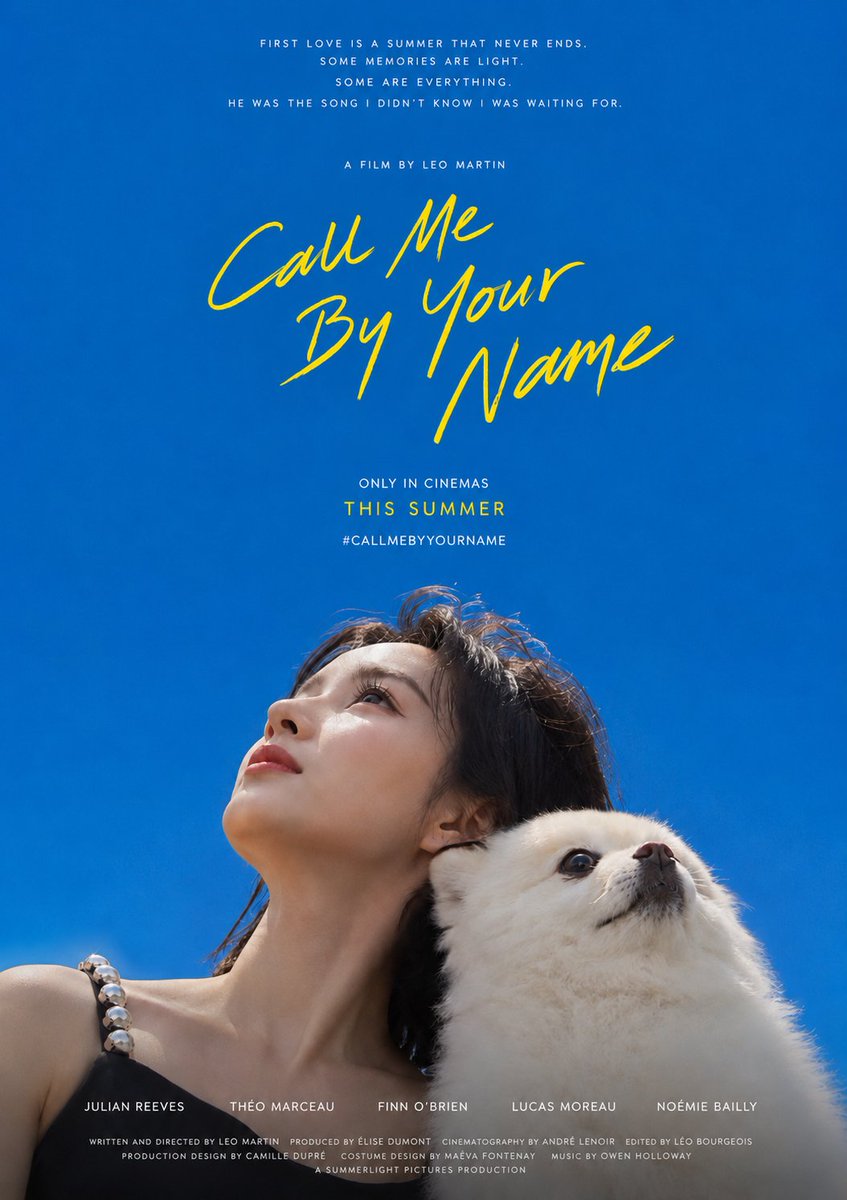
From the photo provided by the user, generate a film-poster-style portrait whose core is a vast, pure color field holding up subjects nestled at the edge of the frame, each gazing up at the sky. About three-quarters of the image is a single clean, saturated, completely uncluttered monochrome field, like an infinitely receded sky, creating an open, wistful, summery breathing room of negative space; the subjects occupy only a narrow band of about a quarter on one side, yielding most of the space to the empty color field. The composition adapts to the aspect ratio: in vertical format the subjects sit along the bottom as a low horizontal row, with the sky extending upward; in horizontal format they sit along one side (e.g. the left) as a vertical row, with the empty color field opening widely toward the other side (the right), where the text falls; in either orientation, subjects and text always sit at opposite ends, and negative space dominates. The camera must be at an extremely low angle shooting upward (a worm's-eye view): each character's head is tilted back, chin raised, throat and neck extended, face turned up toward the empty color field overhead; the viewer mainly sees the underside of the jaw and the profile or three-quarter profile — the characters never face the camera head-on, never meet it at eye level, never make a frontal ID-style portrait, and their gaze does not land on the viewer but is cast toward the sky above. Only the head, shoulders, and a little of the upper body show, with the lower edge naturally cropped by the frame. The type of subject is in no way restricted; everything must follow the objects actually present in the input photo; their identity, number, kind, and combination must be strictly faithful to the original photo, in one-to-one correspondence, without conjuring, copying, multiplying, or adding extra objects that aren't in the scene. The key nestling pose is leaning on one another rather than looking at the same spot: the objects are back to back, head to head, or one rests the back or side of its head on the other's shoulder/neck, leaning toward opposite or different directions, each tilting its head up toward its own side of the sky, gazes scattered toward empty color fields in different directions rather than converging on one focal point; each object keeps its chin raised and looks upward, overall conveying a feeling of nestling, intimacy, and yet individual reverie. Unless the user explicitly asks for repetition or mirroring, do not duplicate the same face or the same object into several. In the empty field far from the subjects, place handwritten title text with dry-brush strokes and slight ligatures, freeform in shape, slightly slanted with hand-drawn charm, arranged in two or three staggered lines, in a bright accent color that contrasts warmly with the main color field (a bright-yellow character, hue adjustable to the theme's mood), so these letters look like a personal signature floating in the air. The title text content defaults to the handwritten English “Call Me By Your Name,” replaced with the user's specified content only when the user provides custom text. The title position adapts to the aspect ratio: in vertical format it sits in the upper-middle of the empty field above; in horizontal format it sits at the center of the large negative space on the side opposite the subjects. Above the title, place a smaller line of thin descriptive text (defaulting to an “a film by …” style); below the title, two or three smaller lines of uppercase information in the accent color or white (defaulting to short poster-style phrases like “IN SELECT THEATERS / NOVEMBER 24 / #CMBYN,” customizable by the user); the vertical version may additionally stack, centered at the very top, several tiny lines of white critic-quote-style phrases, and along the bottom edge press in a white uppercase line of lead-actor names plus a whole block of fine, understated small-print copyright information, forming the complete typographic order of a film poster. The main color field defaults to the original's pure, saturated, slightly deep cobalt blue / azure — a blue like the noon sky of a clear summer day, close to #0A66AC (very low red, medium green, high blue), distinctly blue and not cyan, not grayish, not purplish, not pinkish-blue, and not navy or ink blue; replace the whole thing only when the user specifies another theme color, and even then preserve the same purity, saturation, and high-brightness relationship. The overall color roles are: a single large expanse of pure, high-brightness color field dominating, one warm handwritten accent color (bright yellow by default) as the finishing touch, white text carrying the information, and the people keeping real, natural skin and clothing colors. The image is bright, translucent, clean, saturated yet not dirty, with a gentle air of openness and longing; even with a deeper color field, keep the light clear, the gradation crisp, and the negative space airy, avoiding a grayish, aged, stuffy, smudged, or distressed look. The visual weight stays firmly on the contrast between the vast empty field and the upward-gazing subjects at the edge; the subjects must never be enlarged to fill the frame, never shot frontally at eye level, and never lose the large negative space or the upward, scattered gaze.