
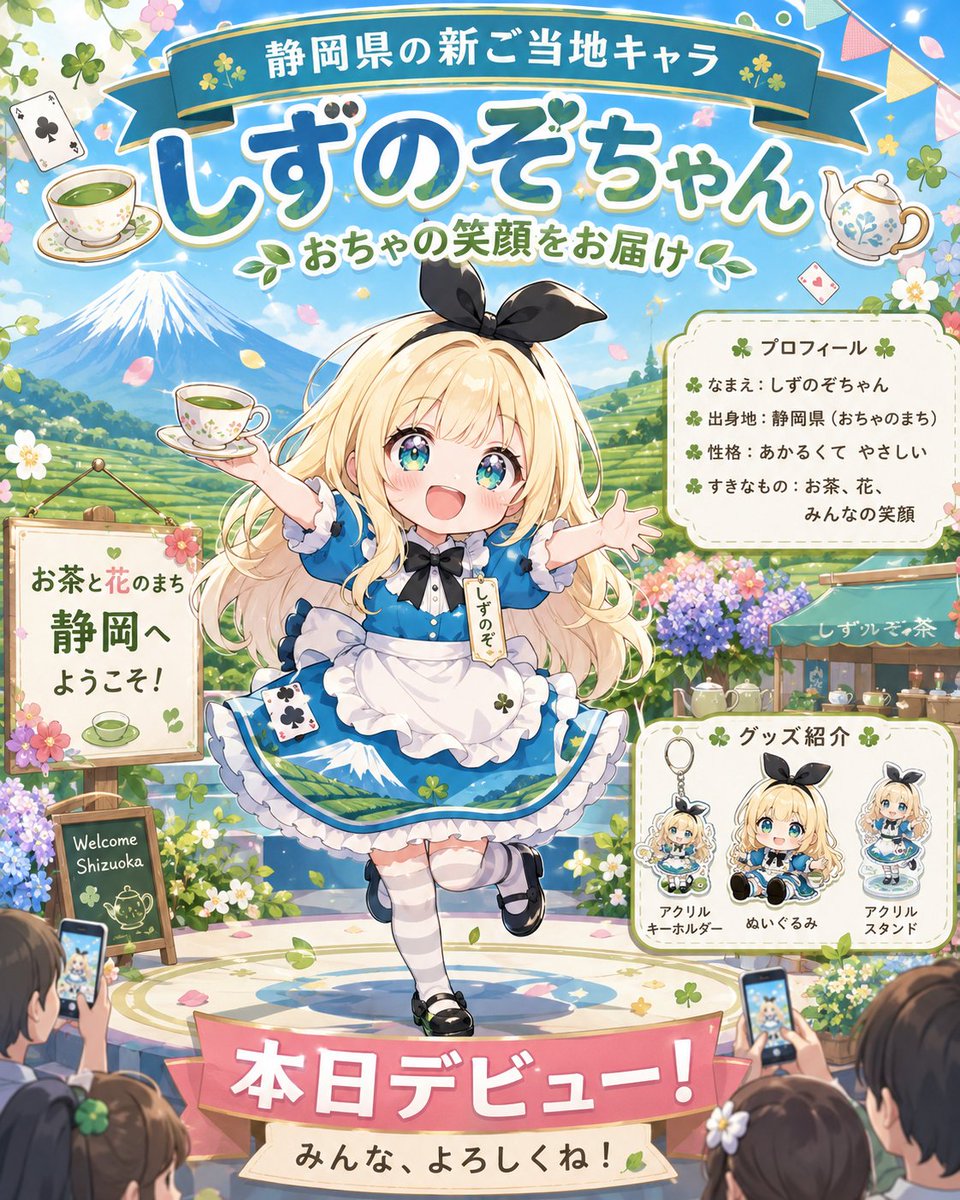
Using the attached character illustration as the most important standard, carefully read the original character's facial features, the impression of the eyes, eye shape, hairstyle, hair color, bangs, face contour, expression, sense of age, impression of the costume, color scheme, motifs, sense of transparency, atmosphere, personality, and the character's unique cuteness and charm. On the theme: "What if this character were a newly born official local mascot representing a certain prefecture of Japan?", reconstruct it as the reveal visual of a non-existent official local character. Input fields Character name: 【enter name】 Prefecture: 【if blank, automatically decide the one that best suits the original image】 Local character name: 【if blank, auto-generate】 Region/sightseeing spot in charge: 【if blank, auto-generate】 Specialty/regional motif: 【if blank, auto-generate】 Short catchphrase: 【if blank, auto-generate】 Image ratio: 【4:5 portrait】 Most important concept This is not an illustration of the character simply traveling. Nor is it a tourism poster with the character merely standing in front of a sightseeing spot. Based on the original character's traits, think about which prefecture it suits, what charm of that land it represents, why it became that region's local character, and what appearance would make locals love it, then complete it as "an approachable, memorable local mascot that really looks as if it is active in that region." Make an image where the viewer instantly thinks: "This one really feels like this prefecture," "the combination with that specialty suits it," "it really looks like it'd be at a station or tourist information office," "which prefecture would my character be?" How to decide the prefecture Do not decide the prefecture randomly. Comprehensively analyze the following elements from the original image and choose only one prefecture that best suits the character: the character's main color; hair and eye color; the material and design of the costume; motifs such as flowers, fruit, animals, sea, mountains, snow, hot springs; personality impressions such as cheerful, calm, energetic, elegant, mysterious; worldviews such as Japanese, Western, natural, urban; the character's sense of season; affinity with regional specialties, scenery, culture, and festivals. Do not decide merely by "pink, so a peach" or "blue, so the sea"; combine multiple traits for a region choice that is convincing precisely because of that character. Always place in the image regional motifs that naturally convey the chosen prefecture. Design of the local-mascot conversion Do not turn the original character into a different person. Be sure to maintain the facial features, eyes, hairstyle, hair color, expression, color scheme, and unique cuteness. However, instead of placing an ordinary human character as is, naturally redesign it into an approachable local mascot design that could be active at regional events and tourist information offices. The figure should have: a slightly large head and an approachable mascot build; a rounded, soft silhouette; a distinctive design recognizable from afar; a design that simplifies the original's hairstyle and costume; a hat, ears, ornaments, and clothing incorporating regional specialties and nature; an expression approachable for children through adults; a design easy to turn into merchandise. But do not infantilize it extremely or fully transform it into an animal; leave enough elements to recognize the original character. How to incorporate regional motifs Rather than simply lining up many of the region's elements around it, naturally incorporate them into the mascot design itself. Examples: a hat or pouch imitating the specialty; a hair ornament using the regional flower; a costume incorporating the shape of mountains or sea; patterns evoking festivals or traditional crafts; a small companion based on a regional animal; accessories symbolizing hot springs, fruit, snow, forests; a cape or ribbon incorporating the region's colors. Don't end with merely having it hold the specialty; make the character itself appear to symbolize the region's charm. Scene and composition Make a composition as if photographing the reveal event on the day the new local character was officially announced. Place the character large in the center so its expression and design can be grasped at a glance even on a small smartphone screen. In the background, naturally place elements conveying the chosen region's character. Examples: a reveal stage in front of a tourist information office; a regional station plaza; a roadside station or product fair; a local festival venue; an official photo space with a sightseeing spot in the background; a sales booth for the mascot's merchandise; nobori banners and commemorative panels; locals taking photos. But do not make the background too prominent; the lead must always be the local character. The character's size should be roughly 45–65% of the whole screen, so it does not get small and buried. Pose and expression The pose should be a clear, cute signature pose befitting an official mascot beloved by locals. Examples: gently introducing the regional specialty; spreading both arms in welcome; waving slightly; taking a regional-motif pose; proudly showcasing the local charm; a slightly clumsy, endearing gesture. The expression should be bright and approachable, a natural smile conveying the original character's personality. Do not make excessive funny faces or overly strong gag expressions. Design with an official feel The whole image should have a bright, clean official design, like an announcement visual of a new local character officially released by a municipality or tourism association. However, do not use the names, logos, marks, or designs of real municipalities, tourism associations, companies, or existing local characters. Create everything as fictional names, logos, and designs. In the image, place as needed: the local character's name; the prefecture name; the region or sightseeing spot in charge; a short catchphrase; a fictional official logo using regional motifs; a small profile section; a mini introduction of commemorative merchandise; reveal-event-style decoration. But do not cram in too much text information. Keep the main readable text to at most about 3–5 words, at a size readable even on a smartphone. Generating the local character's name Naturally combine the original character name, the prefecture name, the region name, the specialty, and motifs of nature or culture, and come up with a memorable, easy-to-call, approachable name. Avoid names similar to existing local characters. Avoid names that are too long, hard to read, or incomprehensible coinages; make a name memorable at a single glance. Generating the catchphrase The catchphrase should be words that briefly convey the charm of the region and the character. Examples: "This town's smile officer," "I came to see you from the sea breeze," "Brightening the town softly again today," "Hello, from beyond the mountains," "Delivering tasty and cute." Keep the copy short and approachable; avoid imperatives and overly strong advertising expressions. Especially important elements in the image: maintaining the original character's face and eyes as the top priority; showing the character large in the center; making the chosen prefecture clear at a glance; reflecting the regional motifs in the character design; a mascot feel that really looks active; not a tourism poster but a reveal image of the local character; a bright, approachable official feel; a result that makes viewers on social media want to try it with their own character too; natural balance of hands, fingers, arms, legs, and body; little, large, readable text. Prohibitions: a composition where the character is merely traveling normally; an illustration where it is merely standing in front of a sightseeing spot; a design that merely lines up many regional specialties; a composition where the character is too small; turning the original character into a different person; costuming (kigurumi) it so much that the original face or hairstyle is unrecognizable; imitating existing local characters; logos of real municipalities or tourism associations; logos of real brands or companies; expressions malicious toward the region; choosing more than one prefecture; a design that does not convey the reason for the prefecture choice; an overly information-heavy tourism-pamphlet-style layout; masses of text too small to read; unnatural hands and fingers, extra fingers, missing fingers; unnatural body, joints, neck, legs; an overly dark background; a lonely all-white background. Final desired image Make an image that, at a glance, conveys: "This character has been officially born as this area's new local character." So that one feels not only the character's cuteness but also the affinity with the chosen prefecture and the region's charm. The finished image should be an attractive visual as a participatory project that makes one think: "I want to try which prefecture's local character my own character would become."