
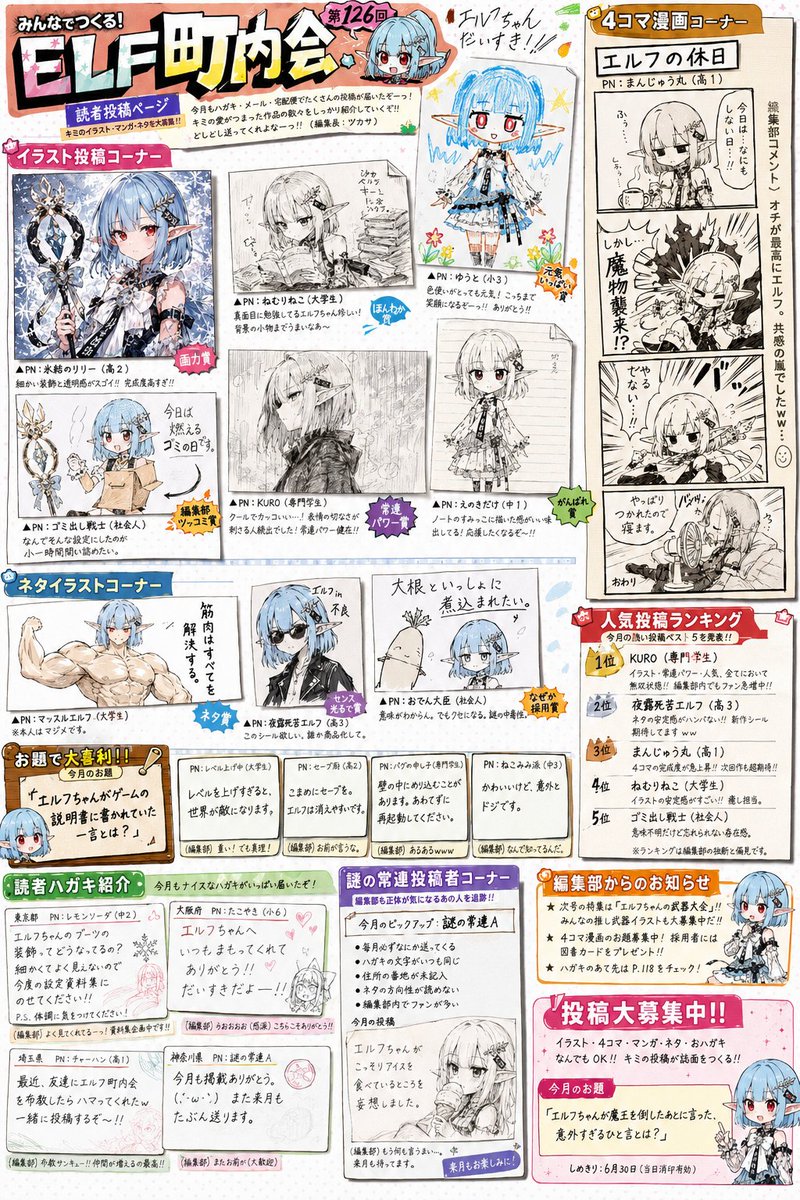
Create a reader-submission section page of an official fan magazine for a wildly popular fictional work, featuring the character from the reference image as the protagonist. This is not a cover. Not a poster. Not an art book. It is a reader-participation submission page found in the middle of a magazine. Draw heavily on the reader-submission section culture of 1990s-2000s game magazines, anime magazines, hobby magazines, and children's magazines. The page contains multiple sections: reader illustration corner, joke illustration corner, 4-panel comic corner, witty-answer (ogiri) corner, editorial comments, reader postcard showcase, popular-submission ranking, mysterious regular contributor corner, etc. — compose them freely. The whole page is colorful and lively, with a hand-laid-out magazine editing feel. The digital design must not be too polished. The character appears in various spots on the page, but not only as official art — drawn as humorous reader submissions. Gags welcome. Parody welcome. Everyday jokes welcome. Mild character-breaking welcome. The readers have loved this work for years and are used to playing around with the characters. The page has many speech bubbles, comments, and editorial quips. All text in natural Japanese. Avoid the nonsensical characters typical of AI. Information density of a truly printed magazine page. Important: the work is fictional, but only the magazine culture should be abnormally realistic. The readers carry the tone of people talking about a real work. It must work as "the reader-submission section of a long-running popular work." No mere character-introduction page. No mere fan-art collection. Prioritize the atmosphere of editors and readers playing together. Each submission must have a distinct personality per author. Naturally mix: master-artist-level high-skill works, advanced amateurs, high-school level, a child's earnest drawing, gag manga, 4-panel comics, doodle-style joke illustrations, pencil drawings, black-and-white manuscript works. Each work must differ greatly in line habits, degree of deformation, skill, composition, manga expression, inking quality, and screentone work. They must not all be in the same art style. It must not look like a collection by a single author. It must look as if the editors selected works from many readers. Reader submissions should not be drawn directly on the page as finished illustrations, but appear as manuscripts actually mailed to the editors, scanned, cut out, and laid out on the page. Each work may differ in paper type, print quality, scan quality, line darkness, manuscript size, and margins. There may be a mix of: works like postcards printed as-is, photocopied manuscripts, parts of manga manuscripts, illustration submissions, etc. The editors don't select works on skill alone. They value humor, inventiveness, gag value, impact, and reader popularity. So very skilled and somewhat clumsy works naturally coexist. Editorial comments differ per work. Playful treatments may exist, such as "Art Skill Award," "Gag Award," "Editor-in-Chief's Burst-Out-Laughing Award," "Published on Momentum Alone Award," "Nobody Knows Why It Was Accepted Award." Especially important: the instant you see the page, it should feel like "this is a reader-submission page from an old game or anime magazine." And the more you look at the details, the more the personality of each contributor, the editors' mischief, the regular-contributor culture, and the history of a long-running popular work come through. Give top priority to the atmosphere of editors and readers playing together for years.