
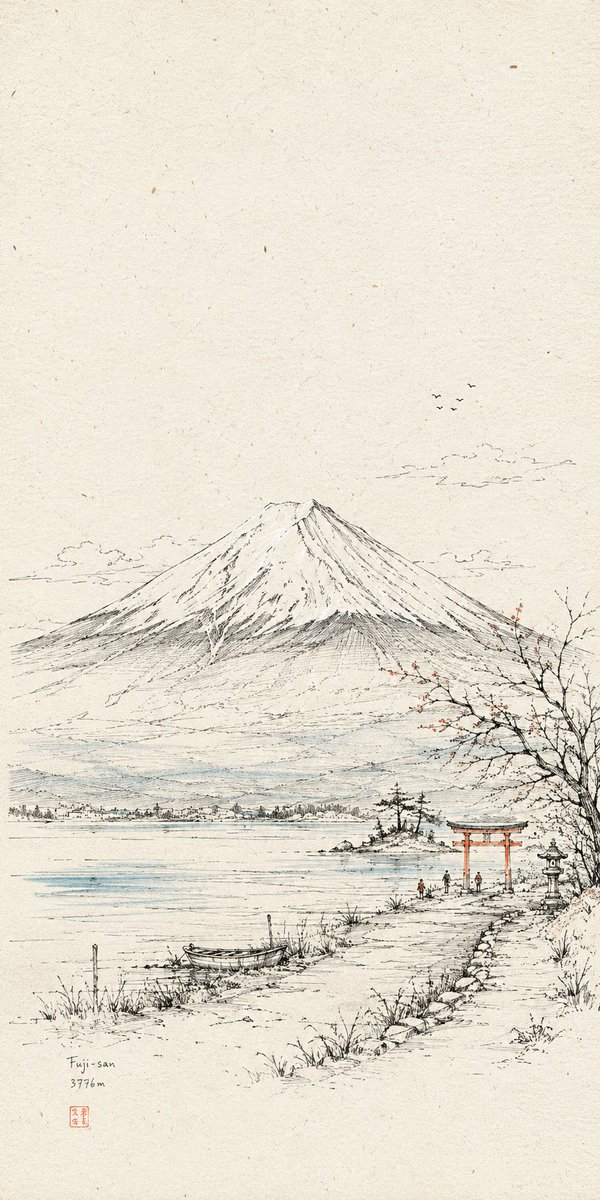
Generate a paper-based line-drawing visual artwork around a concrete subject: first build space, the subject's contour, structural transitions, paths, and scale relationships with extremely fine, slightly hand-drawn trembling lines; then let a few high-purity color planes enter only the most crucial recognition planes, connection nodes, emotional pauses, and information centers; color is not full coloring but edits attention like a precise annotation. Overall, warm off-white paper ground and fine black lines occupy the largest visual area; paper grain, tiny specks, and a slight scan feel must clearly exist; keep ample white space at the top or around so the subject feels observed within a page of a travel journal. The main visual weight gathers in the middle or lower-middle; keep a breathable paper distance around the subject; the composition consists of one clear anchor, a low-density environment layer, and a few colored nodes. The core object keeps recognizable structural lines, contour edges, partial hatching, and compressed detail; first decompose the subject into edges, planes, paths, nodes, scale marks, and semantic environment, then decide which parts may be activated by color; leave non-critical areas to paper color and line work, with no even fill. Details gather along structural edges, openings, corners, junctions, and movement paths; open areas stay paper-empty; line direction obeys the object's semantics; use stable parallel line fields in flowing zones, vertical or cross hatching in shadows, and short broken lines on fragile edges. Volume, shadow, and material are achieved through fine hatching, cross lines, parallel line fields, and variation in line density; lines press over the color planes, and the edges of color blocks carry slight handmade misregistration and paper-grain bleed. The background is generated from the subject's own space or informational environment but may appear only as a low-density line-drawing memory layer, using light contours, depth relationships, sparse marks, and a little hatching to indicate place, time, scale, or semantic pressure; the background is lighter, less colored, and lower in contrast than the subject. Color keeps a controlled warm-cool role division: paper color and black lines hold the whole, a few cool structural colors build space and order, a few warm memory colors light up entrances, transitions, and emotion, and the brightest color serves only as sparse small node pauses; when the subject changes, the hue micro-adjusts to the subject's semantics, but area hierarchy, saturation concentration, warm-cool division, and dotted highlights must stay stable. Add tiny figures, objects, symbols, or functional marks as scale noise, rendered with a few lines and dotted color, giving the space traces of use and the warmth of life; these marks should be small enough to only change the rhythm without becoming the protagonist. If text is needed, use a narrow, restrained, low-interference annotation-style typeface that participates in boundaries, paths, and information hierarchy like the marginal notes of an architectural sketch, keeping the white space intact. The final surface presents the finish of pen line work, colored pencil or thin ink glaze, color under line, slight registration deviation, paper fiber, scan grain, and hand-drawn perspective error, with both accurate structure and a quiet, open, on-site-memory handcrafted texture. Subject: close-up of the Great Hall of the People Ratio 1:2 Use: phone wallpaper