
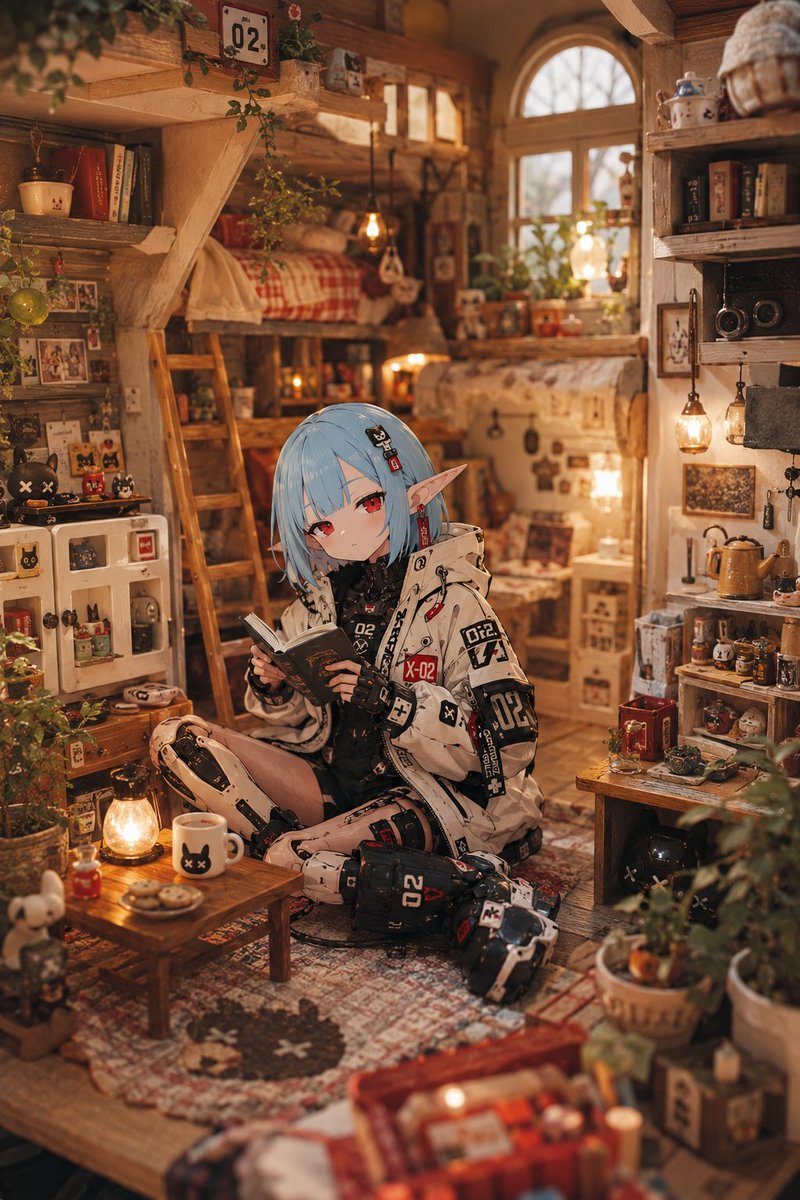
Use the reference image as the base of the character design and depict "a moment of living in a small, cozy world like a miniature." Maintain the impression of the character's face, hairstyle, hair color, eyes, ears, costume, silhouette, body proportions, and expression. Never break the character's identity. The setting is a small, warm living space, like a handcrafted diorama, that suits the character from the reference. Miniature-like architecture. Small furniture. Small household items. A large amount of everyday items and decorations densely arranged like a handmade dollhouse. Give the entire space the lived-in feeling that "someone actually lives here." The character performs natural, everyday actions as if actually living in that space. The character itself also exists as a resident of that miniature world. Make the sense of scale among furniture, household items, architecture, plants, and small props mesh naturally. Do not create a composition where a giant person is squeezing into a tiny room. Depict the space and character as unified at the same scale of that small world. Compose it so the interaction with furniture, small props, household items, and the environment can be felt. Natural clutter. Furniture arrangement that conveys the flow of daily life. Personal belongings. Small decorations. Inhabited spatial density. The space is designed "for living with peace of mind." A calm everyday feeling. The atmosphere of a small town or village. A gentle worldview like a life-simulation game. Quiet everyday storytelling. Atmospheric staging with a sense of the season. Soft interior lighting. Warm color separation. A design that suppresses visual pressure. A friendly background composition. A sense of depth like a handmade miniature. The background is designed with top priority on making the viewer feel "I'd like to live in this small world." Prohibited: cinematic realistic depiction, hyperrealism, horror staging, game UI, HUD, menus, status bars, and interface displays.