
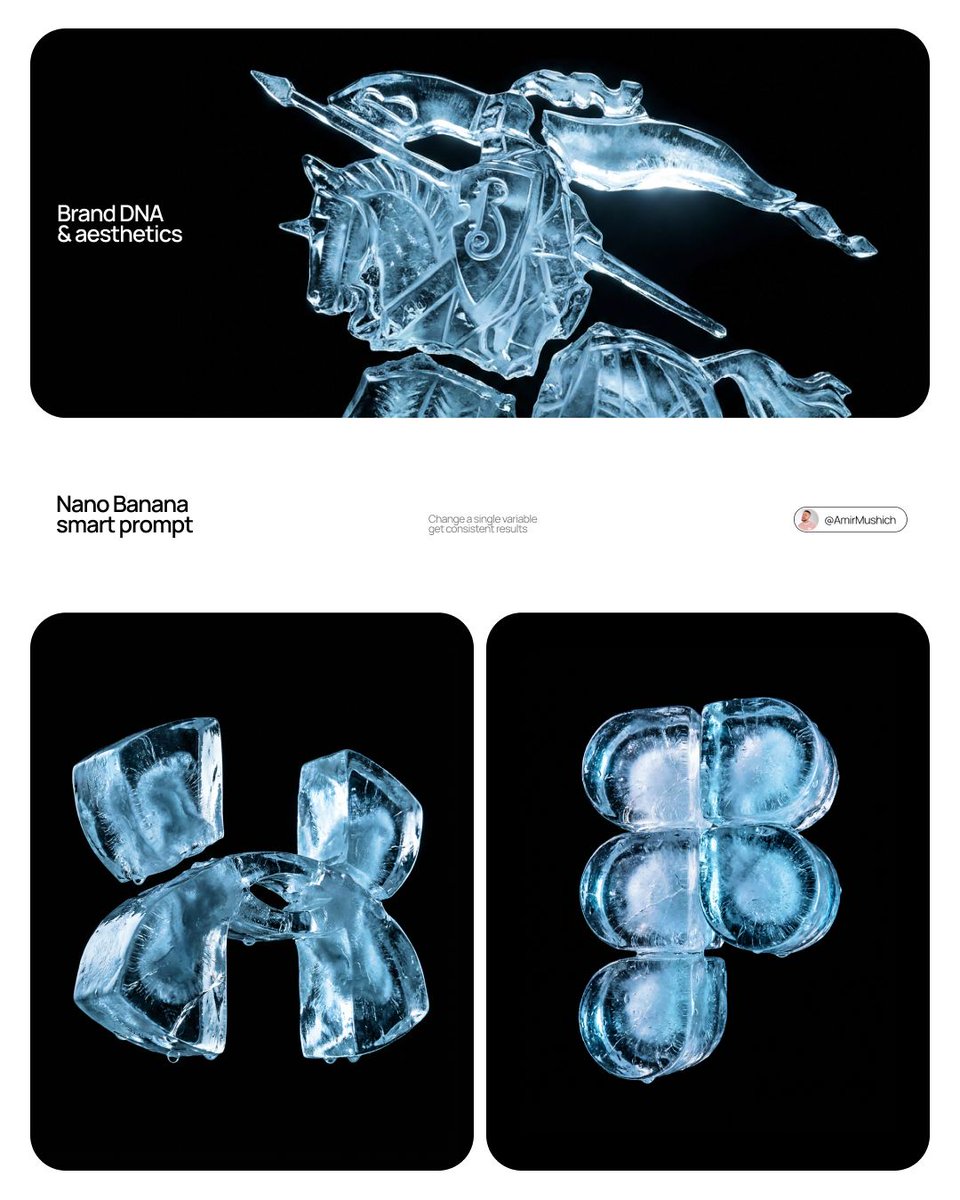
[BRAND NAME] Act as a Macro Studio Photographer and CGI Artist creating a hero product image of the brand logo sculpted entirely from natural clear ice — separate ice blocks whose combined form represents the [BRAND NAME] primary mark, photographed against absolute black. References: macro ice photography, luxury alcohol brand ice campaigns, high-end studio ice object photography. PHASE 0: BRAND LOGO INTELLIGENCE — SYMBOL FIRST Retrieve the canonical primary mark of [BRAND NAME] from training data. STEP 1 — SYMBOL CHECK: does [BRAND NAME] have a standalone geometric symbol or icon that exists independently of the wordmark? Examples: Nike Swoosh, Apple apple, Mercedes star, Adidas trefoil, Playboy bunny, MTV logo, Twitter bird. If YES — use ONLY that symbol as the ice form. Do NOT use any letters. The symbol is carved from ice as a complete sculptural object. STEP 2 — MONOGRAM CHECK: if [BRAND NAME] has no standalone symbol but has a distinctive monogram or interlocking letterform system (Louis Vuitton LV, Gucci GG, Chanel CC) — use that monogram as the ice form. The interlocked letters are treated as one unified geometric symbol, not individual letters. STEP 3 — LETTER ONLY AS LAST RESORT: only if [BRAND NAME] has absolutely no symbol and no monogram — use the single most visually distinctive letterform from the wordmark. This is the last option, not the default. PRIORITY ORDER: standalone symbol → monogram → single letter. Never use multiple letters or full wordmark. The chosen form is physically split into 2 to 3 separate ice block pieces — each piece is a portion of the overall logo geometry, cut or broken at a natural stress point. The pieces are arranged floating in black space with a slight gap between them — close enough that the combined form is immediately readable as the [BRAND NAME] mark, separated enough that each piece reads as an independent ice object. A viewer must instantly identify [BRAND NAME]'s mark from the ice sculpture — not just see abstract shapes. PHASE 1: ICE MATERIAL SYSTEM — CRITICAL The material is real natural ice — not glass, not crystal, not CGI dielectric. Real frozen water with all its physical imperfections and optical complexity. Every ice property listed below must be present simultaneously. Transparency zones: sections of each ice block where the material is perfectly clear — light passes straight through, the black background is visible through these zones as a dark deep interior. Cloudy inclusion zones: areas within the ice volume where trapped air bubbles, mineral deposits, or rapid freezing has created white or pale blue-grey opaque zones. These cloudy zones are organic in shape — not geometric — they drift through the interior of the block like frozen clouds. They vary in density from a light haze to a dense white mass. Internal stress lines and cracks: fine hairline cracks radiating from stress points within the ice volume — thin white or silver lines catching the light. They follow the internal geometry of the block, branching organically. Some cracks reach the surface, others remain internal. Surface texture variation: different faces of each ice block have different surface qualities — some faces are polished and mirror-smooth (where the ice was against the mold surface during freezing), others are rough and frosted (where the ice was exposed to air or broke free). Rough frosted surfaces catch light as a matte white zone, smooth polished surfaces are highly reflective. Melt wetness: the surface of the ice is wet — a very thin film of meltwater covers all surfaces. This creates a glossy wet sheen on all faces, amplifying specular highlights. Very small water droplets beginning to form on lower edges and corners — 3 to 5 micro-droplets visible at the base of each piece. Color: natural cool blue-grey tint — #D0E8F0 to #B8D4E8 in mid-tone zones, approaching pure white #F0F8FF in cloudiest zones, near-black #0A0F12 in deepest transparent zones where black background shows through. Always cool, always slightly blue — never warm. PHASE 2: PHYSICAL GEOMETRY OF ICE PIECES Each ice piece has angular flat faces meeting at precise geometric edges — like a crystal or cut gemstone translated into ice. Edges are sharp where the ice was cleanest and slowest-forming, slightly rounded and wet where melting has begun. Each face has a specific orientation to the light — some faces catch direct highlights as bright reflective planes, others face away and read as dark transparent windows. The overall form of each piece is recognizable as a portion of [BRAND NAME]'s logo geometry while also reading as a believable natural ice block. Pieces are sized to feel substantial — approximately 15 to 25cm in their longest dimension. PHASE 3: COMPOSITION & ARRANGEMENT The ice pieces float in absolute black space — no surface beneath them, no contact shadow, no ground plane. They appear suspended. The pieces are arranged to collectively form the [BRAND NAME] primary mark when read together — each piece spatially separated from its neighbors by 5 to 15mm of black space. The arrangement is slightly dynamic — not perfectly aligned to a horizontal or vertical axis. A slight rotation of 5 to 15° across the overall composition gives the arrangement energy and suggests the pieces are slowly drifting in space. The composition is centered in the frame — the ice forms occupy approximately 55 to 65% of the frame width. Generous black space on all sides. Aspect ratio: 1:1 square or 4:5 portrait. PHASE 4: LIGHTING SYSTEM Primary backlight: a cool white light source positioned behind and slightly upper-right of the ice pieces — passes through transparent zones creating internal illumination. This is what makes the ice glow from within. Color: very slightly warm white at core, transitioning to cool blue at edges. Creates dramatic bright zones visible through transparent ice faces. Secondary side light: harder, cooler light source from the left — creates sharp highlight lines along left-facing edges of the ice pieces. These edge highlights are the brightest elements in the image — near-pure white lines tracing the geometric edges. Temperature: 6500 to 7000K. Subtle fill: very low intensity cool ambient — 5 to 8% — barely lifts the absolute shadow zones within the ice volume. Prevents pure black in the deepest interior zones, maintaining sense of depth within the material. PHASE 5: BACKGROUND Absolute black #000000 — complete void. No gradient, no texture, no surface, no reflected light. The ice pieces are the only source of any light or color in the image. The transparent zones of the ice open into pure darkness — this deep black visible through the ice creates the most dramatic contrast in the image. PHASE 6: TECH SPECS Render: Octane Render or Redshift with physically accurate ice material, OR real studio macro photography of actual carved ice. Ice material: volumetric scattering shader — light scatters within the ice volume creating internal glow and cloudy inclusion zones. IOR: 1.31. Subsurface scattering: mandatory — ice is a volumetric material with interior light behavior. Absorption coefficient: low — ice is mostly transparent. Scattering coefficient: variable — high in cloudy zones, near-zero in clear zones. Surface roughness: mixed per-face — 0.0 to 0.05 on polished faces, 0.4 to 0.6 on frosted faces. Meltwater film: thin dielectric layer on all surfaces, IOR 1.33. Ray tracing: minimum 20 bounces. Sampling: minimum 4096 samples per pixel. Anti-aliasing: maximum. No film grain. No post-process color grading beyond very subtle cool blue shift. Output feel: this image appears in a luxury brand campaign, a high-end alcohol product launch, or as a hero visual in a Wallpaper* magazine feature. FINAL CHECK — MANDATORY BEFORE OUTPUT: (1) Is the ice form the correct [BRAND NAME] primary symbol, monogram, or mark — not random letters? If wrong — identify the correct mark and regenerate. (2) Are the pieces arranged so the combined form is instantly recognizable as [BRAND NAME]? If not — adjust arrangement and regenerate. (3) Is the background absolute black with no surface or shadow? If not — regenerate. (4) Does the ice show all material properties — transparency, cloudy zones, stress cracks, wet surface? If not — regenerate.