
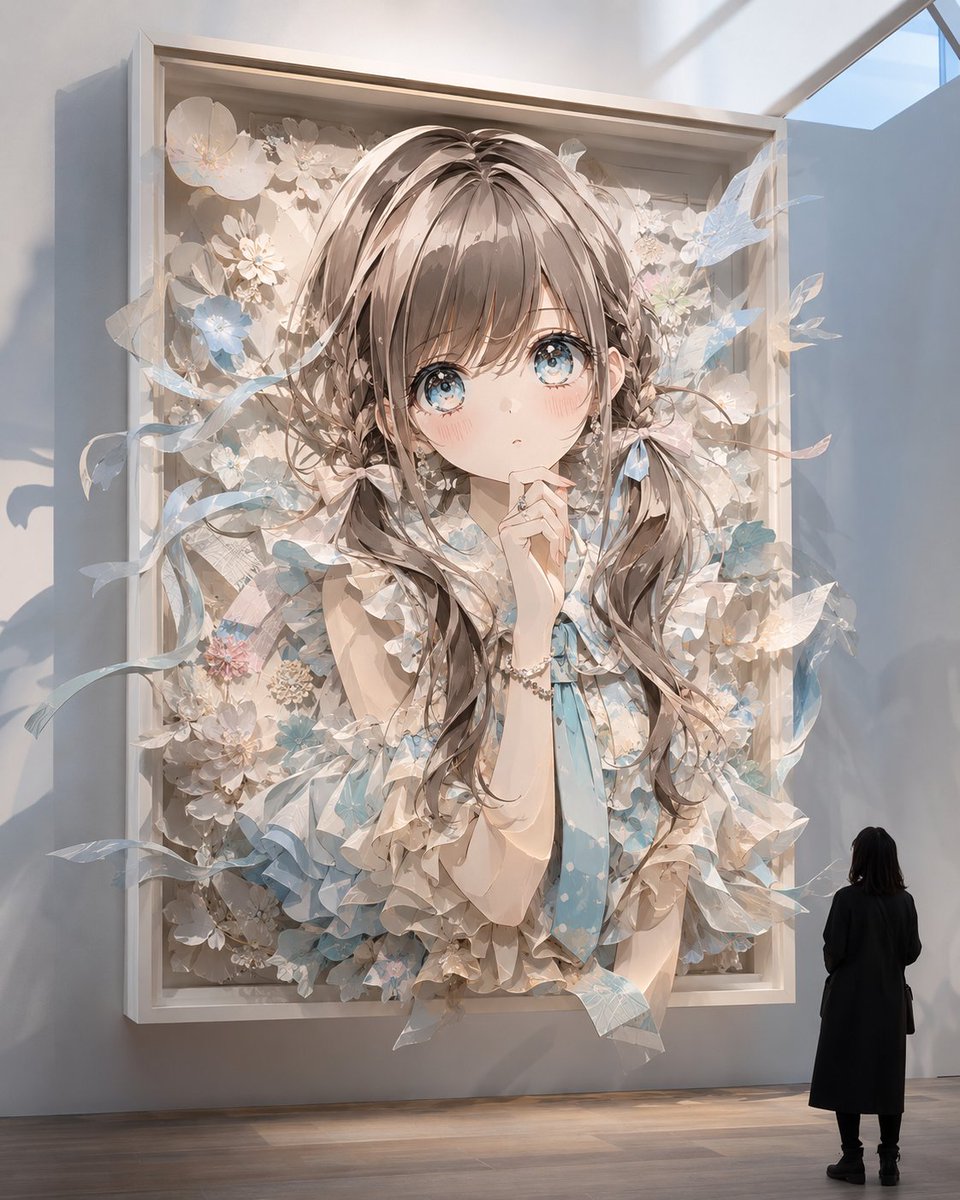
While clearly and faithfully preserving the original character's facial features, eye impression, hairstyle, hair color, expression, outfit, color palette, and atmosphere, reconstruct it as "the moment when a genuinely existing, hyper-precise multi-layered paper-craft artwork exhibited in a museum is bursting out from within the frame into real space, quietly yet vividly." This is not mere illustration editing. Render it as a high-definition photograph of a real three-dimensional paper-craft work actually exhibited in a museum. Expression that merely pastes a printed illustration is forbidden. Leaving only the character itself as an ordinary anime illustration is forbidden. The face, eyes, hair, hands, outfit, flowers, ornaments, and even the background motifs must all be composed as a hyper-precise three-dimensional work made of cut and layered paper. Most important is to simultaneously achieve: "reproducibility recognizable at a glance as the child from the original image," "three-dimensionality befitting a real, actually exhibited multi-layered paper-craft work," and "the refined high-end quality of a museum space." Work structure: not a flat work contained within the frame, but a structure in which multi-layered paper parts protrude in many layers from inside the frame and the character itself bursts greatly out into the space. The face, eyes, hair, bangs, back hair, arms, hands, the outfit's frills, ribbons, flowers, leaves, background ornaments, and so on should each be composed as independent paper parts, in a multi-layered structure floating forward and back in units of a few millimeters to a few centimeters. The paper's layers, cross-sections, thickness, shadows, curling, and slight misalignments should be visible, making it clear at a glance that "it is made by layering many sheets of paper." Important: do not make the character's face itself burst too far out of the frame. Keep the face as the center of the work, staying within the frame to slightly in front of it, and prioritize the cuteness and reproducibility of the original image. What bursts greatly out into real space should center on hair tips, sleeves, ribbons, petals, leaves, semi-transparent paper fragments, and background ornaments. A composition in which only the face looms hugely toward the front is forbidden. Not "the face bursting out," but a structure in which "with the face at the center, the surrounding paper parts overflow into real space." The character itself should protrude semi-three-dimensionally from within a multi-layered shadow box, and the impact of bursting greatly out of the frame should be expressed through the surrounding decorative parts. Character expression: do not impair the original image's transparency, daintiness, and delicacy. Turning it into a different person is forbidden. The eyes especially should be beautiful and keep a clear impression. The flow of the hair, facial features, gaze, expression, and impression of the outfit should be faithfully preserved. However, show it not as a drawn illustration but as a hyper-precise craft work with carefully layered paper. The hair as a structure of many layers of fine paper pieces; the outfit's frills and ribbons expressed through the layering of thin or semi-transparent paper. Flowers and ornaments are also all made of paper, appearing to flutter lightly out into the space. Materiality: nothing other than paper should be the protagonist. Convey the material feel of washi, colored paper, thin paper, semi-transparent paper, and tracing-paper-like materials, and carefully show the paper's fibers, cross-sections, cut edges, slight curling, soft shadows, and the depth of the layers. An appearance like an acrylic plate or a resin figure is forbidden. Prioritize that it be instantly recognizable as a "three-dimensional paper work." Museum space: the background should be a refined contemporary art museum. Clean white walls, generous empty space, beautiful ceiling height, quietness, high-end quality, a minimal exhibition space. Not a room with a lived-in feel, but shown as a high-quality, modern gallery or a high-end museum space. The floor an elegant wooden floor or a refined, somewhat inorganic high-quality flooring. The space tidy, so that the work becomes the protagonist. The exhibition lighting also beautiful, with an elegant quietness throughout the whole space. Lighting direction: soft natural light streaming in from the upper or lateral side of the museum. Elegant light entering from large windows, skylights, or architectural daylighting strikes the work beautifully, accentuating the three-dimensionality of the paper layers and the protruding parts. The light not too divine, treated as refined natural light. By the streaming light, the paper's cross-sections, translucency, the way shadows fall, and the depth of the space should appear impressive. Exhibition lighting and natural light in harmony, creating the brightness and shading befitting a high-quality museum photograph. Foreground figure: place a person appreciating the work rather small in the front of the frame or near the lower right. This person is not the protagonist, but merely a presence that reinforces the sense of scale and the feeling of "really being exhibited." Make the person smaller than now, at a size that sets off the size of the work. The clothing and hair color in calm dark tones such as black, dark brown, or charcoal gray, with an overall dark impression or a restrained, half-silhouette-leaning presence. Do not render the person's details too much; it is enough to convey that the gaze is directed toward the work. The protagonist is always the exhibited work, and the foreground figure, as a supporting role, should not stand out too much. Composition: show the work large as the main element. The foreground viewer smaller, in a composition that conveys the overwhelming presence of the work. A sense of distance at which the whole frame and the three-dimensionality bursting greatly out of it are clearly visible. Getting so close that the overall structure becomes unclear is forbidden. Pulling back so far that the character's cuteness and precision are lost is also forbidden. Make it a strong, highly visible composition that, the moment it is seen on social media, makes one feel "What, is this a three-dimensional paper craft displayed in a museum?!" Atmosphere: daintiness, transparency, quiet splendor, elegance, and the persuasiveness of a real exhibited work. Without leaning too far into fantasy, with a level of completion that could plausibly be seen in a real museum. While having the surprise of a "bursting-out picture," do not make it a cheap-looking production. Prioritize refinement, high-end quality, and quiet emotion. Prohibitions: do not leave it as merely a printed-and-pasted original image; do not leave only the character itself as an ordinary anime illustration; do not make the foreground figure too large; do not make the foreground figure bright and flashy so that it becomes the protagonist; do not make a cluttered exhibition space; do not make an overly pop exhibition; do not make a screen so dark that the work cannot be seen; do not make a mere white-background exhibition; do not make a flat work with weak three-dimensionality. Final goal: while keeping the reproducibility recognizable as "the child from the original image," create a refined, photographic-style exhibition visual in which a hyper-precise multi-layered paper-craft work, really exhibited in a museum, appears to burst beautifully out from within the frame into real space. Place the foreground viewer small, dark, and restrained, the museum space high-quality and modern, and, with natural light streaming in, make a single image in which the three-dimensionality and beauty of the work stand out.