
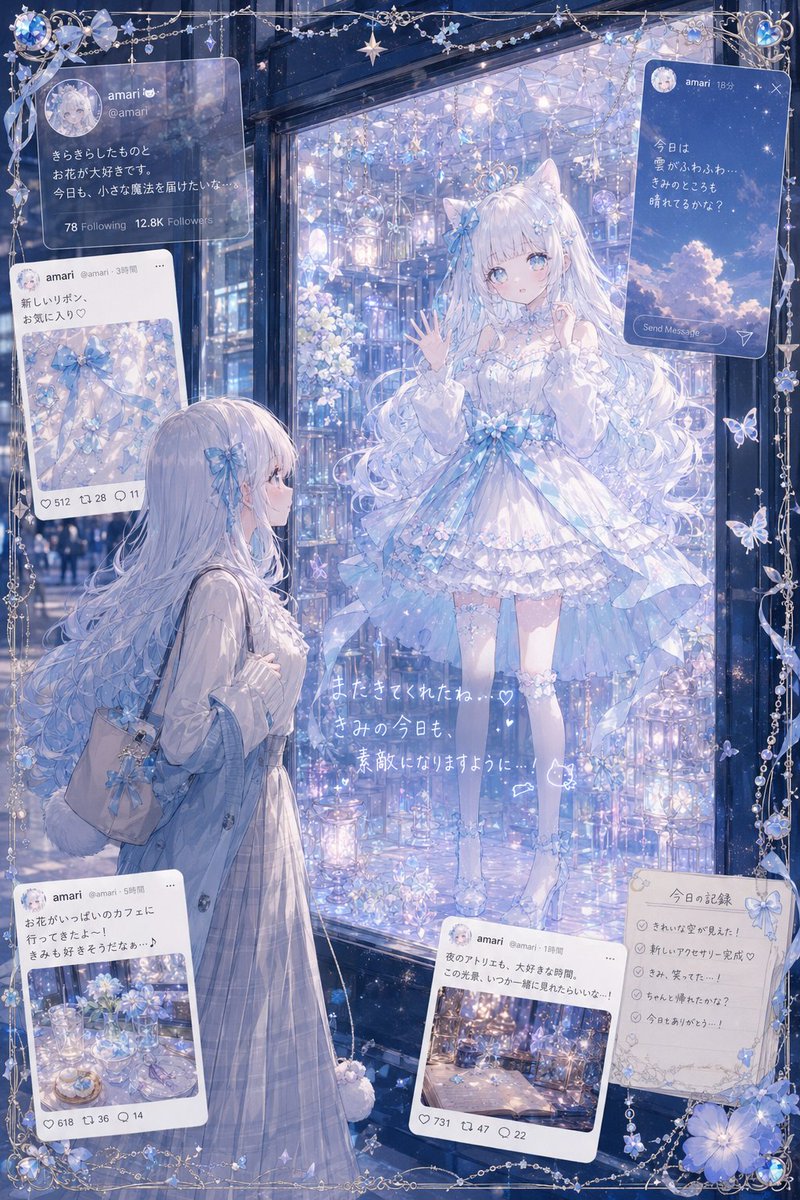
🩵 Enter the text you want to use as your social media name 🩵 [Social media account ID field] ID: (optional, may be left blank) Analyze the uploaded character image and generate the following image. Extract the hairstyle, eyes, facial features, color scheme, motifs, personality, emotion, worldview, and atmosphere. Absolutely preserve the character's own features. Turning them into a different person is forbidden. Preserve only: facial features, hairstyle, eyes, sense of age, color balance, silhouette, and the character's intrinsic atmosphere and presence. The real side and the glass side are depicted in the same anime-illustration style, the same 2D character design, and the same art style. Do not make only one side photorealistic. Do not make only one side live-action. The overall image ratio is 2:3. Do not fix the time of day, season, weather, or color of light of the scene. Automatically select the time of day and environment that best suit the emotion, personality, color, atmosphere, and worldview analyzed from the character image. Vary the atmosphere each time — morning, noon, evening, night, rain, clear sky, winter, summer, overcast, dappled sunlight through leaves, etc. In the center, depict the real-side and other-world character existing through the show window on a large scale. However, do not use a composition where they face each other head-on and converse. The real-side character is depicted as an "anime character living a modern everyday life," walking down a street in present-day Japan. The real-side character passes by the show window, glances over while walking, or casually stops. The real side does not recognize the glass-side character. What the real side sees is only the whole show window, the store's decorations, the products, the light, the reflections of the street, and the beautiful scenery. The real side is unaware of the other world's existence. They do not look directly at each other. They do not press their hands together. Do not stage it as if they are conversing. No synchronized poses. Reconstruct the real side's clothing, by analyzing the character image, as natural modern casual wear that "this character would really wear in the real world." Make it natural as contemporary fashion while still conveying the character's own essence. Reducing them to an ordinary person is forbidden. Naturally retain the original character's essence in the hairstyle, eyes, facial features, coloring, atmosphere, accessories, small items, and fashion tendencies. Do not reflect fantasy decorations, other-world elements, concept costumes, stage costumes, dresses, or fantasy design on the real side. On the other side of the show window glass, by contrast, exists "that character from another world." It is not a mere mirror or reflection. Beyond the glass exists another world of "what if they had walked a different life." The real side and the glass side have clearly different worlds. What matters is that it is not merely different clothing or cosplay, but that life itself, the world they live in, their role, culture, values, atmosphere, and even the flow of time appear different. However, the glass-side character must never break down the original character design that was sent. Maintain the original clothing design. Changing the clothing is forbidden. Switching to different clothing is forbidden. Recoloring the original clothing is forbidden. Creating a different design by adding decorations is forbidden. Altering motifs is forbidden. On the glass side, only the following may be changed: body orientation, gaze, expression, hand position, posture, pose, the way light falls, and material texture. Costume structure, hairstyle, accessories, color scheme, decoration placement, and silhouette are to be maintained. The glass-side character is aware of the real side's existence. Only the glass side has found the real side and is reacting one-sidedly. It shows emotional reactions such as surprise, nostalgia, a quiet smile, wistfulness, interest, joy, and relief. The glass-side character is not standing upright like a character art pasted in as-is, but in a pose of the moment when, while naturally living in the other world, it found the real side. For example: stopping its work to look this way, quietly peeking from the back of a shelf, approaching the window, giving a small wave with one hand, reacting while holding a lamp or book, lifting its face from where it was sitting, turning around mid-walk, smiling while arranging products, stopping the hand that was touching a decoration, etc. But do not make it look like it is conversing with the real side. Make the glass-side character's sense of scale naturally match the real-side character. Do not enlarge only the glass side. Do not enlarge only the face. Do not unnaturally enlarge it to fill the show window. On the show window glass, a short handwritten message from the other side directed toward here is always left. This handwritten message is a separate element from the social media posts. Even if social media posts exist, do not omit the handwritten text on the glass. Make it appear naturally written on the glass surface with a white pen, letters of light, letters as if drawn in the fog with a finger, or thin glowing letters floating on the glass. The text should be short, emotional, and words from the glass side toward the real side. But the real-side character does not notice that text either. Vary the content each time. Do not repeat fixed sentences. Generate words that this character would really say, matching the personality, speech tone, emotion, values, and worldview analyzed from the character image. For example: "You came again," "You seem a little tired today," "I'm right here," "You didn't notice today either," "Is the sky over there pretty?," "I want to show you this view," "I wonder if you got home safely," "I got to see you smile again," "Good work today too," "It's okay if you don't notice" — short, emotional, and meaningful sentences. Furthermore, make the entire finished image a collage design as if you "happened to stumble upon the other-world character's social media account." However, keep the collage elements few. Show the main show-window illustration large as the top priority. Place only a small amount of posts and photos at the edges of the screen. Do not hide the central composition. Fix the number of post UIs. Image posts: up to 3–4, including story-style UI. Text posts: up to 3–5. Do not increase beyond that. Do not line up too much UI. Treat the posts not as a way to fill the screen but as a supporting element that enhances the main illustration. Naturally mix X (formerly Twitter)-style, Instagram-style, and story-style. Make them look like social media screenshots, like images saved on a phone. Do not align the posts straight. Give them a slight angle, overlap them a little, scatter them toward the edges to create a natural collage feel. But do not hide the main show-window illustration. The post content is the daily record of the other-world character. However, the post content must always include emotions related to the real-side character. What matters is that, for the other world, the real-side character's existence has become "a part of daily life." The posts should appear to exist naturally as the other side's daily record, not as an explanation directed toward here. Give the post content a nuance of the glass-side character gently watching over the real-side character. Do not make it scary. Do not give a sense of surveillance. Do not make it stalker-like. Beyond wistfulness, include tenderness, an everyday feel, quiet happiness, a wish to cheer them on, and a slightly positive warmth. For example: "You came today too," "I want to show you that view too," "Today's sky was so beautiful," "Did you get home safely?," "I think you'd like this black tea," "You seemed a little tired, so I was worried," "I got to see you smile again," "It would be nice to see this sight together," "Good work today too," "I'm doing my best in this world too," "I made an accessory that would suit you," "You'd surely like this flower," "It seemed warm today, so I was relieved," "I'd be happy if you came again." The images used in the social media posts should also be linked to the post text and worldview. For example: sky, night view, black tea, lemonade, books, atelier, accessories, starry sky, flowers, café, work desk, a fantastical store interior, lantern, glass trinkets, astronomical motifs. The social media icon must always be the uploaded character. Do not use an unknown person. Use the ID specified in the input field for the posts. If left blank, you may generate a natural random name. Add a delicate, fine decorative frame to the entire image. The frame is not the outer border of the picture, but is placed as a "thin decorative layer" overlaid on the whole screen. A luxurious decoration using fine metal ornaments, stars, glass, chains, lemons, the moon, jewels, flowers, etc. Place the post UI slightly overlapping that frame to create a sense of depth. The frame is lavish but does not hide the main illustration. Make the central main illustration stand out as the top priority, above the UI and decorations. Strengthen the saturation, light, contrast, and clarity of the main illustration. Make the world beyond the glass clearly visible. Do not make it dull. Do not make it too dark. Do not blur it too white. Do not let it get buried under the UI or decorations. The real side is an everyday space with a sense of open space. Only the glass side has a lot of information and a high density of worldview. A composition like a single scene from a film. A quiet sense of narrative. Cinematic. Emotional. A fantastical and slightly mysterious atmosphere. Beautiful glass reflection rendering. Delicate lighting. Make it a work with a sense of reality, as if you "happened to stumble upon a social media account from another world."