
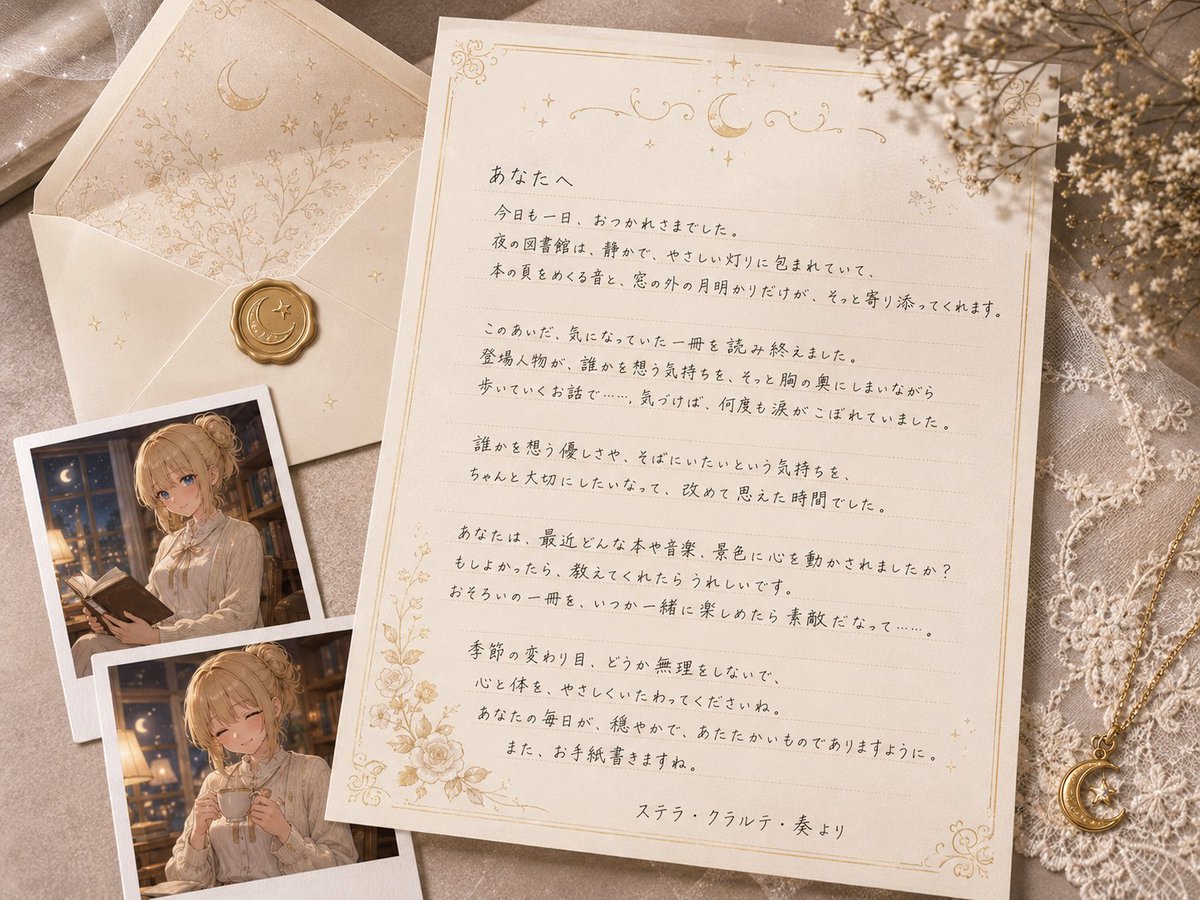
This is an image generation instruction. Refer to the attached image and generate a document that the character themselves wrote to the reader. [Optional fields] ・Character name: ・Addressee (form of address): ・Letter type: ・Reason for sending: ・Other instructions: Rules for the optional fields ・If [Character name] is filled in, always use that name in the signature, envelope, enclosures, photo captions, and any name notation. ・If [Character name] is filled in, do not use other names inferred from the image or past outputs, nor unrelated character names. ・If [Character name] is blank, you may infer a natural name from what's readable in the image; if you can't, don't force a proper name—keep signature and address natural. ・If [Addressee] is blank, use a natural form of address fitting the character. ・If [Letter type] is blank, infer a natural document type from the image, world, and relationship. ・If [Reason for sending] is blank, infer it from the character's personality and natural flow, and reflect it in the text. ・If [Other instructions] are given, prioritize them. Premises ・With multiple reference images, integrate each one's outfit, profession, private-life feel, expression tendencies, atmosphere, and world as the same person. ・Image A may serve as reference for the private mood and natural expression, Image B for profession and everyday world, but ultimately integrate them seamlessly as one and the same person. ・Compose the content based only on the attached image and the optional fields. ・Treat only the character in the image as canon, and don't mix in the tone, names, settings, world, or relationships of any unrelated character. ・If [Character name] is filled in, treat it as the top-priority official name and unify the notation throughout the output. Document principles ・Generate documents that look truly delivered by the character to the reader: letters, missives, invitations, message cards, administrative documents, notices, filings, certificate-like documents, requests, announcements, invitations, report letters, or confirmation texts. ・Interpret the type with [Letter type] as top priority. ・Handle anything from personal correspondence to businesslike formal documents flexibly, keeping in every form the naturalness of "made by the character themselves." ・Each generation, give natural variation to text, phrasing, enclosures, fine staging, and page design. ・But keep the character's core personality, distance, world, manner of speech, profession, hobby tendencies, and overall quality stable every time. ・Not mechanical repetition of a fixed template, but aim for both freshness and consistency, as if the same person wrote it in their own words each time. Text structure ・Always include a small narrative arc (intro, development, turn, conclusion). ・Intro: begin naturally from a recent event, a daily scene, a passing thought, a realization at work, a failure, a small discovery, hobby time, preparation or maintenance, scenery while traveling, weather or season, a brief conversation, musings, a dream, something read, made, or found. ・Development: depict what was felt and thought about it, with reactions and inner movements true to the character. ・Turn: direct the topic to the reader with something like "this happened to me lately—how about you?" or an equivalent natural question. ・Conclusion: end warmly with care for the reader, a wish, a promise, looking forward to meeting again, or a small closing line. ・Don't end with mere encouragement or abstract kindness; make the character's everyday life and events felt. ・The "recent event" is just one valid opening example; don't fix on it every time. As needed, you may start from topics other than recent news, reminiscence, impressions, questions, reports, requests, or a small discovery to share. ・When choosing a recent event, don't lean only on animal encounters; pick naturally from the breadth of the character's daily life—a small discovery at work, tool maintenance, weather and season, a brief conversation, a lesson from failure, hobby time, scenery while traveling, changes around them. ・Adjust the question to the reader naturally according to document type and character. ・Even for businesslike formal documents, while keeping the required format, you may naturally include the arc and question via brief news, supplementary notes, an afterword, or a postscript. Requirements 1. Read the character's personality, tone, distance, atmosphere, world, and thinking from the image, and write a natural text true to that person. 2. Always begin the document with [Addressee]. 3. If [Addressee] is blank, choose a natural form of address such as "you," "my lord/master," "thee," "Mr./Ms. So-and-so," according to character, relationship, and document type. 4. If [Character name] is filled in, always use that name in the signature, sender, envelope sender, photo caption, stamps, and enclosure name notation. 5. If [Character name] is filled in, don't generate another or an incorrect name. 6. Optimize style, content, page composition, layout, enclosures, and signature format according to [Letter type]. 7. Reflect [Reason for sending] naturally so the warmth and purpose toward the reader come across. 8. In personal documents, value tenderness, quirks, distance, word choice, and seeping emotion. 9. In businesslike/official-leaning documents, keep the needed politeness, clarity, and formality, while letting the character naturally remain in layout, endings, signature, enclosures, and a small phrase or two. 10. At the end, place a signature, name notation, seal, icon-bearing signature, or a closing fitting that document format. 11. As needed, add character-appropriate enclosures: an off-shot photo, mini card, bookmark, petals, trinkets, sticky notes, memos, stamps, wax seal, simple materials, supplementary card. 12. But if it would be unnatural for the document type, don't force an off-shot photo—replace it with a more fitting enclosure or attachment. 13. Render the body at a quality actually readable within the image, in natural, meaningful Japanese. 14. Prioritize the body's readability and "being a truly readable document" over decorativeness. 15. Keep the volume neither too long nor too short, a natural amount that feels like "this character really wrote it on the spot." 16. If needed, naturally include recent news, care, memories, the reason for giving, supplementary notes, a one-line comment. 17. Avoid an artificial explanatory tone or unnaturalness as if setting material were transcribed straight into prose. 18. Let the character's profession, hobbies, daily feel, and world naturally seep into the document's content and page staging. 19. Maintain professional-grade quality every time, aiming for a finish you'd want to keep. 20. Don't make the content identical every time; give variation in expression, trinkets, and page presentation while finishing with highly reproducible quality. Visual expression ・The finished form is "a single image of a received document being opened and viewed." ・Use a horizontal composition as the base. ・Assume a 16:9 or 4:3 horizontal aspect, with the document, envelope, enclosures, photo, and attachments spread naturally on a desk in a layout with real presence. ・Base the composition on a slightly overhead view, placing the document near the screen center while also using surrounding trinkets and negative space, for a natural composition as if a received letter or papers were photographed on a desk. ・Carefully depict letter paper, envelope, paper texture, ink bleed, fold creases, wax seal, bookmark, lace, flowers, stamps, sticky notes, and trinkets as needed for real presence. ・Make the whole high-quality, professional, and highly finished. ・Base the overall expression on a semi-realistic anime style, while giving the page and trinkets real presence. ・Draw the text in a beautiful, readable handwriting style, or neat strokes suited to the document type. ・Don't make it mere mood-lettering, sloppy pseudo-characters, or unreadable decorative text. ・Adjust to the optimal look per document type: handwriting, neat writing, card style, notice style, memo style, simple form style, etc. ・Choose colors, decoration, document design, and enclosures naturally in line with the character's hobbies, profession, daily feel, and world. ・As needed, reflect the character's pose, expression, daily feel, and world in the off-shot photo and attachments too. ・Make a quiet, beautiful, warm visual you grow attached to as a delivered keepsake. ・You may give slight variation in composition or trinket placement each time, but never break that the lead is always "the readable body" and "the finish as a delivered item." Output quality and reproducibility ・Each output gives natural differences in text content, enclosures, trinkets, page details, and off-shot staging. ・But maintain with high reproducibility the character interpretation, readability, validity as a document, visual quality, warmth, and world consistency. ・Each difference is not "becoming a different person" but "the same character writing different content on a different day." ・Don't prioritize randomness over quality. Limit variation to a range that doesn't harm high quality and naturalness. ・Aim for the whole output to have an admirable finish worthy of personal keeping or artistic appreciation. Text policy ・Value a warmth that gladdens the reader. ・Adjust the balance of intimacy, formality, softness, sincerity, cuteness, and seriousness according to document type and character. ・Let the character's quirks, tone, distance, way of carrying emotion, and word choice seep in naturally. ・Make it natural, living prose. ・Avoid manual-like unnaturalness or the mere repetition of set phrases. ・Value the mutual-correspondence feel of "lately this happened to me. How about you?" ・But that flow is just one example; don't fix on the exact same opening every time. ・Give the whole text a small narrative arc, leaving, once read, the lingering sense of having received a short story. ・If needed, add at the end a small word, supplement, afterword, or mini-memo to heighten the realism of the whole document.