
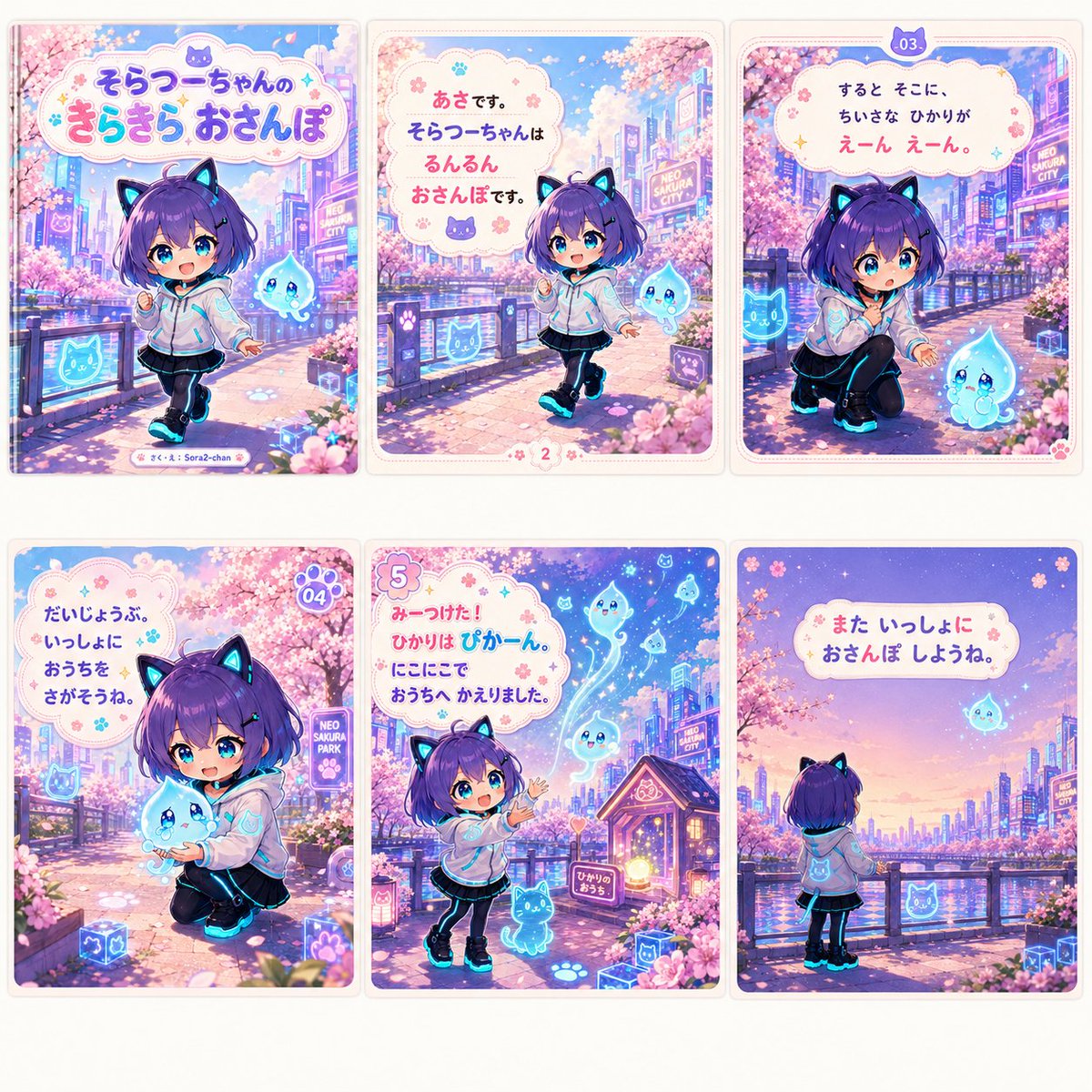
Generate images based on the attached image and the production conditions below. This prompt is not a request for proofreading, evaluation, improvement suggestions, or confirmation. Even if there are slight contradictions or ambiguities, interpret them naturally as far as possible and ALWAYS execute the image generation. Do not point out problems with the prompt or ask follow-up questions; produce the finished image according to the specified conditions. 【Input fields】 The following are the production conditions. Produce the work referring to the contents of these input fields for the prompt body. Book genre: ※If blank, produce it as a character gravure (visual photobook). ※e.g.: picture book / shōnen manga / shōjo manga / children's book / encyclopedia / character book / light-novel-cover style / setting & design collection / product-manual style / presentation-material style / cookbook. Page count: ※If blank, produce 6 pages. ※If specified, you must produce a structure with exactly that number of pages. Do not conclude in a single page. Title: ※If blank, automatically generate a title suited to the content and genre. Optional theme/story: ※If blank, automatically generate the content from the character in the attached image. Head-to-body ratio: ※If blank, keep a ratio and impression close to the character in the attached image. Art style: ※If blank, use a refined, commercial-quality touch suited to the genre. Target age: ※If blank, produce it for all ages. 【Prompt body】 Treat the character in the attached image as the reference character, and refer to the input fields above as production conditions. In accordance with the "Book genre," produce a high-quality book work with the completeness of commercial-publishing level. If the book genre is blank, produce it as a character gravure. First, carefully read the reference character's appearance, expression, costume, hairstyle, accessories, color scheme, pose, atmosphere, and worldview. On that basis, naturally imagine the character's personality, background, daily life, emotional habits, symbolic motifs, role, strengths, and position within the story or on the page, and construct content that best brings out the character's charm and individuality. The total page count should follow the "Page count" field. If blank, produce 6 pages. If specified, you must create a book structure with that number of pages. Do not end with a single cover image or a standalone visual; in accordance with the specified page count, produce a continuous book work including the cover, body pages, and final page. The page count includes the cover, body, and final page. The cover is mandatory. The final page should provide a closure appropriate to the book genre. For example, for a picture book or manga, a back cover or an ending with lingering resonance; for an encyclopedia or setting collection, a summary or supplementary page; for a manual or presentation style, an overview or ending page; for a character gravure, a final cut with resonance or an ending page with a profile — choose an ending natural to the genre. Each page should clearly stand as a complete single-page visual in its own right. Not a mere list of illustrations: create a composition in which the meaning, flow, and role of turning the page can be felt. Divide the generated content per page according to the specified page count. For example, for 6 pages: page 1 as the cover, pages 2–5 as body or development pages, page 6 as the final page. As needed, include on each page a page number or elements that naturally convey its role as a page. In accordance with the "Book genre," optimize the page structure, layout, amount of text, role of pages, information organization, and staging methods. As needed, naturally use headings, body text, speech bubbles, panel layout, diagrams, labels, supplementary boxes, comparison elements, annotations, captions, and so on. If the book genre is a story-driven format such as a picture book, manga, or children's book, you must use a kishōtenketsu (intro-development-turn-conclusion) structure or an equivalent natural narrative structure. Not a mere list of scenes: design it so each page has meaning and emotion, situation, highlights, resonance, and the fun of turning the page arise. If the book genre is a format that emphasizes information and organization, such as an encyclopedia, character book, setting collection, product-manual style, presentation-material style, or cookbook, use a logical structure natural to the genre. For example: introduction, overview, feature introduction, usage examples, comparison, supplements, summary, step-by-step explanation, recipe introduction, profile, visual gallery, etc., in a natural and readable flow suited to the content. Still, not a mere list of information: make the reference character's charm and worldview come alive. If the book genre is blank and produced as a character gravure, compose it as a visual book that brings out the reference character's charm. Develop naturally according to the specified page count: cover, profile introduction, everyday cuts, pages showing the charm of expressions and outfits, pages that convey the worldview, and a final page with resonance. Finish it as a commercial-quality gravure/visual book that emphasizes elegance, atmosphere, character, and a sense of bookmaking, without explicit sexual depiction. If "Optional theme/story" is filled in, use it as the foundation. Even if it's a short note or bullet points, grasp the intent and reconstruct it into a natural structure suited to the specified genre. If "Optional theme/story" is blank, automatically generate content true to the character based on elements read from the reference character. For the story's details, staging, composition, background setting, sub-characters, striking props, introduction items, and page staging, actively apply AI-original ideas and playfulness so that each output has a different charm. The character's head-to-body ratio should follow the corresponding field. If blank, keep a ratio and impression close to the reference character. Throughout all pages, prioritize that the character be consistently recognizable as the same character, without greatly altering facial features, hairstyle, the basic elements of the costume, color impression, and atmosphere. The art style should follow the corresponding field. If blank, use a refined, commercial-quality touch suited to the genre. Throughout all pages, maintain unity in art style, color, shading, background, atmosphere, page design, and sense of bookmaking. Adjust the amount of text, word difficulty, depth of theme, amount of information, density of illustration, and emotional expression according to the "Target age" field. If a target age is given, compose with readability, comprehensibility, emotional conveyance, and thematic depth suited to that age group. If blank, produce it for all ages with readable, approachable expression. Include on each page natural sentences or text suited to the specified genre. Keep the amount of text not too large, within a range that does not impair the page's readability and visibility. Picture book: short, gentle sentences; manga: speech bubbles and monologues; encyclopedia/reference: headings and explanatory text; manual/presentation style: key-point summaries and explanatory text; cookbook: ingredients, steps, tips; character gravure: title, short introduction, profile, captions, poetic copy — optimize according to the genre. If "Title" is filled in, use that title as the work title. If blank, automatically generate a striking title suited to the content, character, genre, and atmosphere. Place that title naturally on the cover as needed. The result should not be a mere collection of illustrations, but a high-quality, high-definition book work that has narrative or compositional power, character, gaze guidance, layout, readability, page completeness, a sense of bookmaking, and emotional flow or information organization. Furthermore, importantly: while maintaining high reproducible quality, make fresh differences arise each time in the story's details, staging, composition, background, props, page layout, in-page presentation, color transitions, emotional expression, and supplementary elements, leaving ample room entrusted to the AI. Not too fixed, yet with an unwavering core — aim for "a book work that looks like the same character no matter how many times it's generated, yet is a little different each time."