
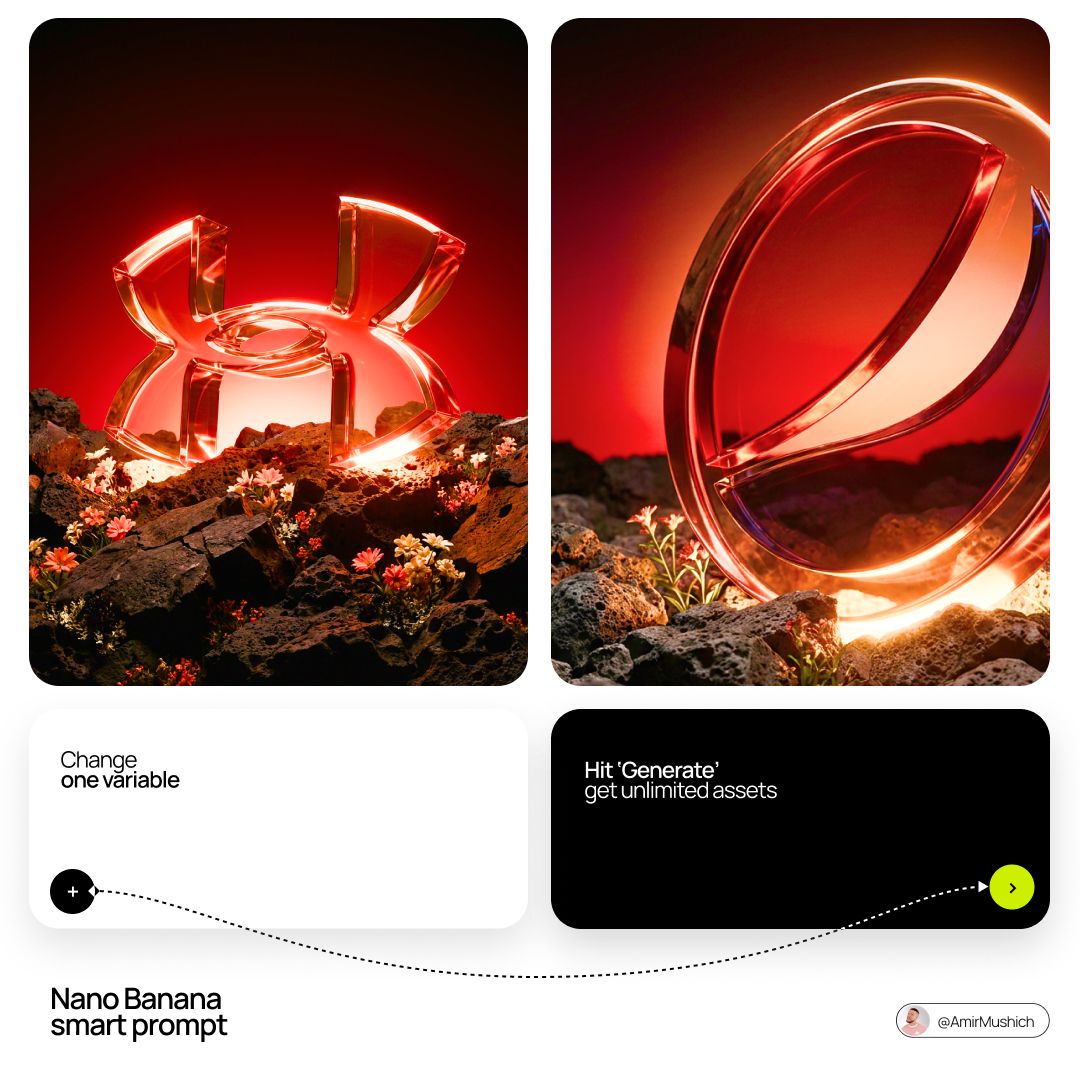
[BRAND NAME] Act as a CGI Art Director and Environment Photographer creating a cinematic hero landscape with a glass logo sculpture emerging from a volcanic rock formation. References: editorial CGI landscape photography, crystal and glass object photography, volcanic terrain macro photography, dramatic sunset landscape cinematography. PHASE 0: BRAND LOGO INTELLIGENCE Retrieve the 100% canonical trademark-accurate primary mark of [BRAND NAME] from training data. Identify the single most iconic reduced form — symbol, monogram, or wordmark. Fidelity test: a brand designer must recognize this as the correct mark. The glass treatment is applied ON TOP of the correct logo geometry — transformation happens after accurate reconstruction, never instead of it. CRITICAL — NO ADDED CONTAINERS: do not add any enclosing shape, circle, oval, badge, or housing around the logo unless that container is part of [BRAND NAME]'s official canonical logo. The glass object is the logo form itself and nothing else. PHASE 1: GLASS LOGO OBJECT — CRITICAL The canonical logo mark of [BRAND NAME] rendered as a solid three-dimensional optical glass sculpture — thick, physical, monumental, with the exact silhouette of the [BRAND NAME] logo. Object depth: 25 to 40% of the logo's total height. All faces polished to sub-micron smoothness. Edges sharp and precise. Bottom cut at a slight bevel — allows the sculpture to stand embedded in rocks below. Tilted backward 5 to 8° — monolithic standing-stone quality. SCENE-INTEGRATED GLASS MATERIAL — CRITICAL: the glass is not a neutral colorless object dropped into the scene. It is a physically accurate optical material that absorbs, refracts, and reflects the scene's ambient color environment, tinted by the red-orange atmospheric environment. Ambient color absorption: warm red-orange volume tint #3A0A00 at 8 to 12% opacity. Transmission color: warm orange-red light. IOR: 1.5 to 1.7. Reflections carry the red gradient of the background and warm orange of the back light. Edge glow warm orange #FF8C00. Internal caustics amber and orange. Overall appearance: a warm amber-tinted luminous crystal that feels native to the volcanic red landscape. PHASE 2: VOLCANIC ROCK GROUND The glass logo stands on and is partially embedded in a formation of volcanic basalt rocks. Dark grey to near-black basalt #1A1A1A to #2D2D2D. Rough, fractured, vesicular surface. Large anchor rocks 15 to 30cm on outer edges, medium rocks 5 to 15cm in the center, small fragments at the base. Lit from behind and below by warm orange back light. Rock formation occupies lower 30 to 35% of frame. PHASE 3: BOTANICAL DETAIL Between rocks: small wild alpine/volcanic flowers — orange, coral, and off-white, 2 to 4cm. 8 to 15 clusters. Thin green stems. Catch the back light as bright orange-lit small forms against dark rock shadows. Patches of dark green or grey-green lichen on rock surfaces. PHASE 4: BACKGROUND & ATMOSPHERE Background: pure atmospheric gradient — deep saturated red-crimson at horizon (#8B0000 to #AA1100) transitioning to absolute black (#000000) at top. No clouds, stars, or details. Most saturated red in lower 30 to 40%. Most intense behind the logo. Perfectly smooth, no texture or noise. PHASE 5: LIGHTING SYSTEM — SCENE AMBIENT DRIVES EVERYTHING Primary back light: warm orange-amber source behind the object at ground level, hidden behind rocks. Color #FF8C00 to #FF6600, high intensity. Passes through the glass creating edge glow and internal caustics, lights rocks and flowers from behind, creates a bright halo on the background behind the logo. Secondary ambient — RED SCENE ATMOSPHERE: the whole scene bathed in red ambient #8B0000 to #AA1100, low intensity, omnidirectional, filling shadows and tinting the glass. Cold top ambient: subtle blue-grey from above, only 3 to 5%. LOGO BASE ACCENT LIGHT — SEPARATION & FOCUS: dedicated light directly below the logo aimed upward. Color #FF9500 to #FFCC00, warmer and more yellow. Intensity 40 to 60% of the back light. Narrow focused upward cone; base brightest, falling off toward the top. Enters through the bevel creating an internal luminous gradient; bottom edges glow in a bright yellow-orange line. Upward caustics cross the downward ones. Lights rocks and flowers beneath the base in a warm amber pool. Separation effect: the logo appears to float and radiate light, commanding full attention as the absolute focal point. PHASE 6: COMPOSITION & CAMERA Aspect ratio: 4:5 portrait. Logo at vertical center — base ~35% from bottom, top ~80%. Rocks in lower 30 to 35%. Camera slightly below the object's midpoint, elevated 5 to 10°, looking very slightly upward, monumental presence. Frontal to the logo, zero horizontal rotation. Slight depth of field. PHASE 7: TECH SPECS Render: Octane or Redshift — physically accurate glass with full caustics and scene-accurate color absorption. Ray tracing: minimum 16 bounces. Glass: dielectric shader, IOR 1.5 to 1.7, transmission 0.95, volume absorption #3A0A00 density 0.08 to 0.12, roughness 0.0. Caustics at maximum. Reflections carry scene colors. Rock: PBR shader, roughness 0.85 to 0.92, vesicular displacement, albedo #1A1A1A to #2D2D2D, metalness 0.0. Background: gradient #AA1100 to #000000. Back light: area light orange #FF7700. Base accent: spot #FF9500 to #FFCC00, 40 to 60%. Red scene ambient: #990000, 15 to 20%. Cold top ambient: blue-grey 3 to 5%. Anti-aliasing maximum. Minimum 2048 samples. No film grain. Output feel: cinematic editorial CGI — a luxury brand film still. The glass must feel like it was born in this volcanic red world, radiating light from within.