
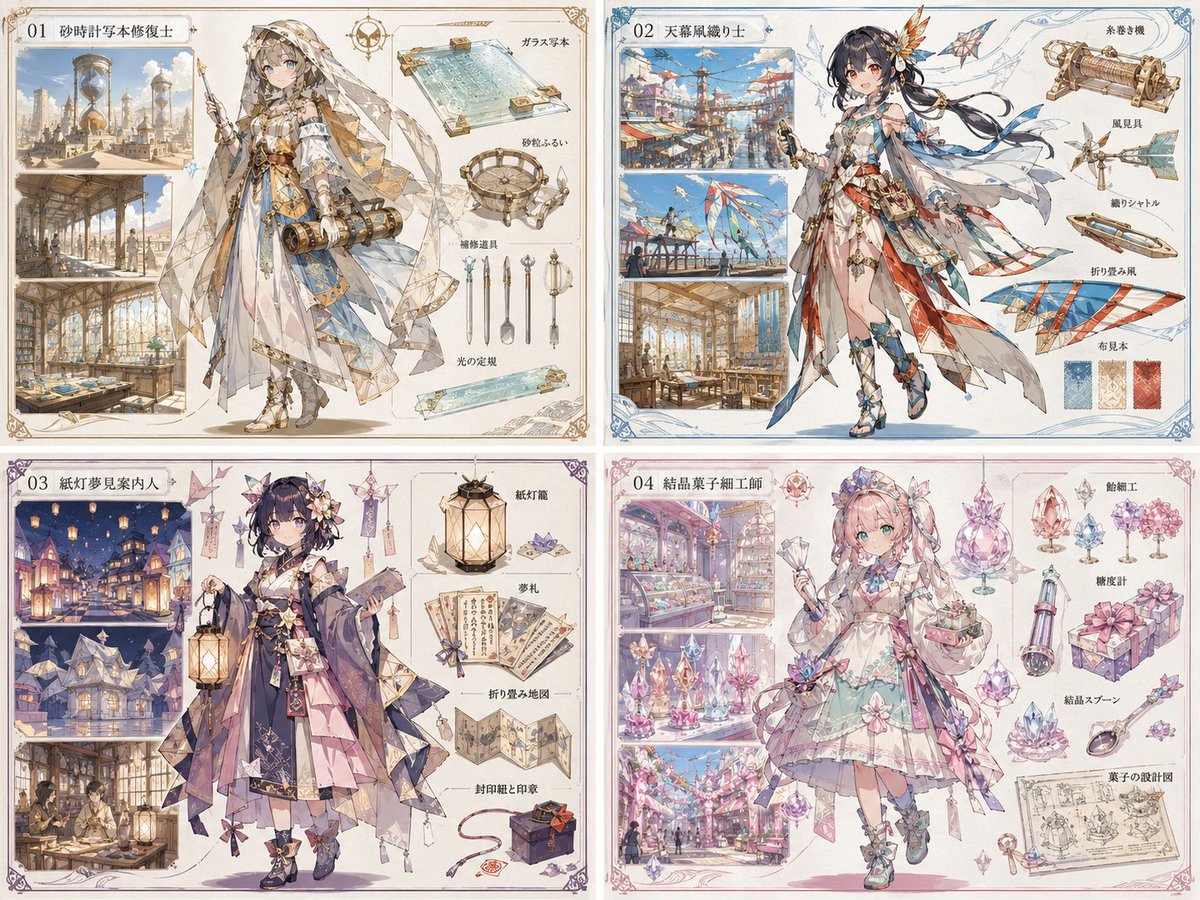
[WHAT TO OUTPUT] World-setting sheet + original anime character sheet. Visualize not only the character but the environment, culture, institutions, technology, and daily life of the world they inhabit. [WORLD SEED] enter here [NUMBER OF WORLD PROPOSALS] enter here (just one / compare several, etc.) [NUMBER OF CHARACTERS] enter here [ROLE/FUNCTION] enter here [SETTING/ENVIRONMENT] enter here (if little is specified, design climate, terrain, resources, dangers, transport, and dwelling forms from the input words) [SOCIETY/INSTITUTIONS] enter here (design community rules, role division, status expression, belonging seals, exchange methods, and rituals) [TECHNOLOGY/FAITH/TABOO] enter here (naturally derive material processing, recording, communication, prayer, taboos, festivals, and body adornment) [DAILY CULTURE] enter here (dwelling, food, transport, work tools, way of dressing, meaning of ornaments, seasonal events, currency, writing, crests) [OVERALL MOOD] enter here [FEATURES OF THE WORLD] enter here [WHAT TO PRIORITIZE] enter here [FINISH DIRECTION] enter here (e.g., strengthen daily-life feel / mystique / clothing practicality, show more architecture, make it bright and child-friendly, etc.) [DIFFERENTIATION INSTRUCTION] enter here [ART TONE] Smooth lineart, flat anime coloring, restrained cel shading, shadow in only one step, no gradients, no thick painting, no realistic textures, no strong light/shadow, a flat look easy to animate. [ANIME-CONVERSION INSTRUCTION] Keeping the structure, motifs, palette, role, and cultural meaning of the original design, simplify the drawing for anime episodes. Use flat anime coloring and shadow in only one step. Make translucent materials and thin fabrics cel-anime style organized by planes, not realistic texture. Based on the above, create an image in the style of an original anime's "world-setting sheet + character sheet." Purpose: convey visually not just the character but the very world they live in—environment, culture, life tools, architecture, transport, and the origin of clothing shown as a whole. Most important: first extract the "visual rules" unique to that world from the input, and reflect them across background, architecture, tools, costume, palette, materials, crests, and page layout. Desired finish: clothes/tools/dwellings that look like everyday use for these people; character, background, tools, writing, and material samples that look from the same cultural sphere; a unique environment, resources, and customs born from the world seed; forms born of practical need rather than genre clichés; a shape, color, and material language recognizable at a glance as "only this world." Process: 1) decide the environment (climate, terrain, light, seasons, dangers, difficulty of movement, resource imbalance); 2) decide life (dwelling, food, work, travel, storage, exchange, recording, celebrations); 3) decide clothing and tools (how they fasten, layer, carry, protect, show status/function); 4) decide the character's look via costume, equipment, material, palette, and silhouette—not face or hair; 5) decide page layout from the world's visual rules. Must include: 1) World board (symbolic landscapes, streetscapes, living spaces, facilities, terrain, climate; life tools, signs, crests, currency, writing, vessels, furniture, vehicles, work tools; palette, main materials, shape language). 2) Character sheet (full-body standing pose, costume conveying function, costume-detail/equipment/back/carried-item drawings; individuality via costume and cultural signs, not face/hair). 3) World–character link (clothing and equipment clearly born of the world's environment, institutions, technology, faith, and customs, with practical reasons and meanings for fastening, storage, aids, and carried items). 4) Page design (layout suited to the world, reflecting its recording medium and diagram style, little text—short English labels, numbers, arrows, symbols; official artbook/concept-art-sheet style). Differentiation rule: across proposals and characters, do not repeat shape language, terrain/environment, architecture, main material, palette, costume silhouette, equipment structure, cultural signs, clothing purpose, or layout mood. Presentation: high resolution, anime style, delicate lineart, clean cel coloring, artbook/concept-art-sheet style. Mixed layout of world board + full-body figure + equipment/tool details; small background cuts, architectural sections, tool diagrams, crests, and material samples as appropriate. Titles, numbers, and English labels minimal, visuals first. Final goal: a design that conveys the world's formation, the inhabitants' life, material constraints, cultural meaning, community rules, and technology. Give a unity so the character, background, and tools all read as from the same world; if the worldview differs, make it recognizable as a different lineage at a glance.