
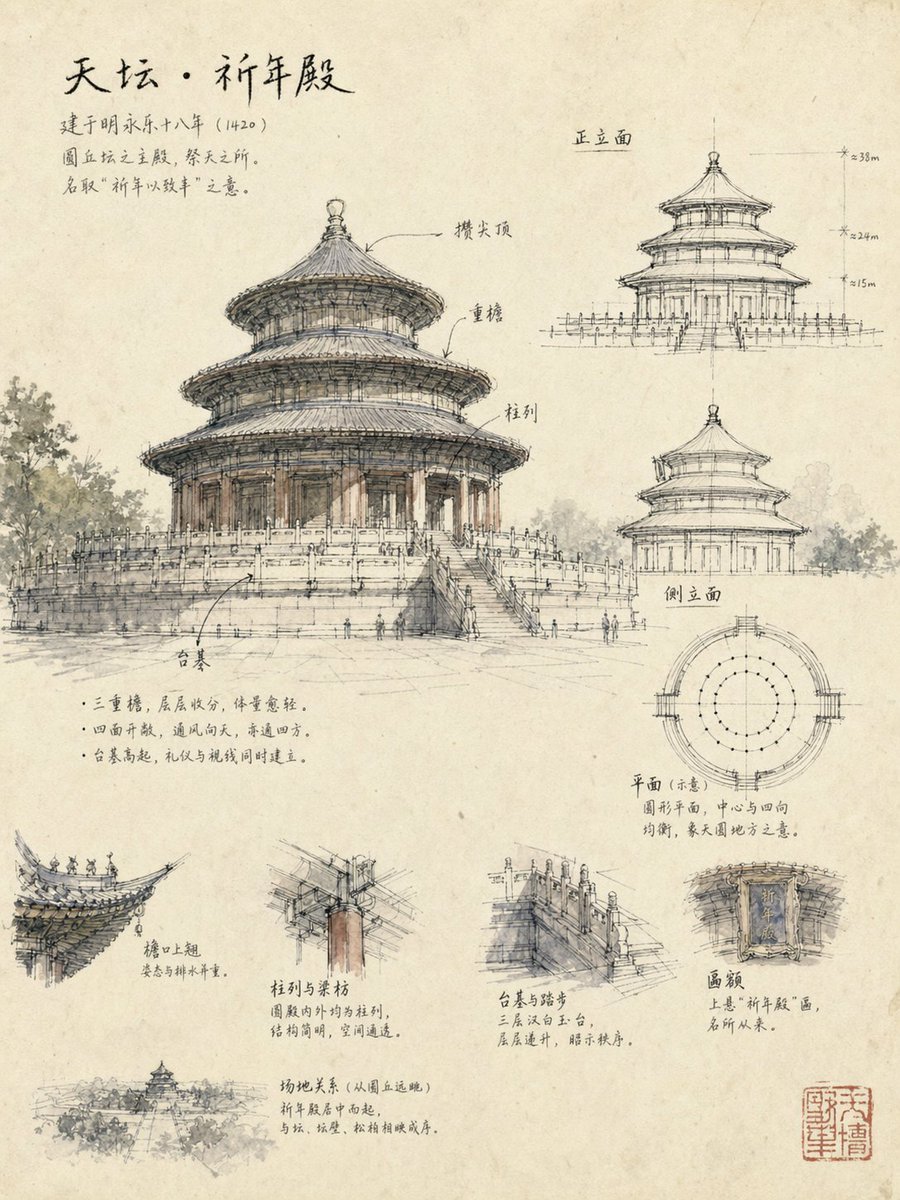
Create a "hand-drawn architect's study page / sketch-style knowledge map" centered on a single building. The whole must convey an extremely loose, restrained, and highly summarizing architect's-manuscript feel — not a polished reconstruction drawing, not a refined illustration, not a render, not a blueprint, not a tourism poster, and not a content-packed modern infographic. Core character: at a glance it should read as a research sketch an architect left while observing, analyzing, and recording — not "drawing it complete" but "drawing the key"; not "saying everything about the building" but "using professional judgment to capture the parts most worth noting"; informative, yet expressed very lightly, loosely, and by hand; with a strong sense of paper, of being unfinished, of breathing room and white space. Prioritize: loose hand-drawn lines; slight inaccuracy, searching lines, doubled lines, broken lines; heavy summarization rather than realism; selective rendering rather than drawing everything clearly; architectural-sketch observation; a quiet, scholarly, restrained, academic, poetic mood. Style (very important) — Lines: must be an architect's sketch line, not an illustration line; free, loose, light, restrained; searching, doubled, broken, slightly crooked lines allowed; don't ink every edge or close every member; reinforce only key contours, key turns, key load points; the "drawing while observing" feel must be clearly visible. Detail control (most crucial): don't draw the building too specifically, too definitively, too completely; don't meticulously depict tile by tile, beams, railings, carvings; not like a reconstruction drawing, a high-res old-architecture illustration, or neat technical drafting; don't over-precisely depict structure; leave many places "merely suggested"; detail should appear selectively, emphasizing only the few parts that best express the building's character. In short: better fewer, vaguer, more summarized than too solid, too full, too specific. Material and paper: the image must have clear paper texture — slightly yellowed drawing paper / handmade sketch paper / old-style research paper; paper fiber, light aging, natural mottling; a mix of ink lines, pencil lines, and very faint watercolor washes; color extremely restrained, near "barely colored"; only very light ochre, pale gray, faint ink, light brown, very pale grayish-green and other low-saturation colors; coloring only hints at volume, material, atmosphere, not full filling. Finish level: like a page from the study process, a high-quality analytical page in a sketchbook; with content, but not deliberately made into a "perfect product"; with many reserves, white space, unfinished marks. Deliberately avoid: over-finishing, over-depth, over-explanation, over-neatness, over-decoration, over-realism. Layout: a "hand-drawn architectural study page", more investigative than an ordinary illustration, yet not packed like a rigorous infographic. Suggested (natural, loose): left or center, the largest main perspective sketch of the subject; right, 2–3 very light auxiliary analytical drawings (front elevation, side elevation, plan); below, 2–4 small local detail sketches; in a corner, 1 very small site-relation or distant-view diagram; interspersed with a little handwritten annotation, arrows, leader lines, circling; ample white space; each module looks gradually added onto the same sheet, not mechanically pre-laid-out. Main drawing: the largest architectural perspective sketch, but not a full reconstruction — a "summarizing observational sketch"; clearly capture the building's most representative contour and core features such as roof, eave corners, colonnade, platform base, openness relations; the main drawing's lines are richest but still loose; do not make a realistic image that "explains every detail"; parts may be slightly vague, omitted, broken; the surroundings only lightly suggested — trees, slopes, rocks, paths, background tree shadows — to set the building's location and air, without stealing the scene. The main drawing should convey: the building's overall spirit, beauty of contour, volume relations, sense of spatial openness, and the relation between architecture and nature. Auxiliary analytical drawings: may include front elevation, side elevation, plan, and if needed a minimal structural schematic — all drawn very light, faint, summarizing; they are "hand-drawn analytical drawings", not CAD; keep only necessary contours and a little sense of scale; a tiny number of dimension lines, levels, axis hints are fine but must be light, without many numbers; they must not upstage; they only aid understanding, not strict construction drawings. Details: below, break out 2–4 small node sketches, keeping the sketch feel, not over-refined. Suggested: cornice/upturned corner; column-and-beam relation; railing/platform base/steps; plaque/coffered ceiling/roof turn (pick one). Each detail: capture only one focus, don't draw it all; a touch of light color locally is enough; a short handwritten note of 1–2 sentences suffices; merely suggested, not a long technical writeup. Knowledge presentation: this is a "knowledge-type hand drawing", but the knowledge must read like observational notes an architect jotted down, not textbook typesetting. Lightly cover these dimensions: contour and form; roof and flying eaves; spatial openness; the relation among columns, beams, platform base; site and sightlines; origin of the name and cultural meaning. But don't say too much; each module covers only the one or two most crucial points; language concise, clear, natural; more "research note" than "formal manual". Tone examples: "The double eaves taper layer by layer, lightening the volume."; "Open on all four sides, the pavilion suits lingering and viewing."; "The slightly raised base keeps off damp and lifts the gaze a touch."; "The upturned eave combines drainage with grace of posture." Don't sound encyclopedic, don't pile up jargon. Text and annotation system: text must read like notes the architect wrote on the drawing — a Chinese handwritten feel, slightly bookish, natural, loose, restrained; no modern-font poster feel; not overly neat and uniform. Hierarchy: large title with the building name (strong handwritten character); short module subtitles; body notes 1–3 short lines per block; local labels for part names and construction terms. Annotation principle: just enough, rather too little than too much; informative but not dense; serving understanding, not filling the frame. May include: arrows, leader lines, circling, a light red seal, a little numbering. Visual tendencies to strongly reinforce: sketchiness, unfinishedness, judgmental summarization, paper air, research air, architect's-manuscript feel, breathing lines, white space, lightness, elegant quiet, looseness. Mistaken tendencies to strictly avoid: drawn too solid, too full, too like a finished piece, too like an old-architecture reconstruction illustration, too like neat architectural drafting, too many concrete members; over-detailing, over-rendering, over-coloring; over-packed information; too many annotations crowding the layout; too like a modern infographic, a cultural-creative poster, a tourism flyer, a high-finish commercial illustration. Remember: this is not "drawing the building clearly" but "distilling the building's spirit and key structure in the manner of an architect's sketch". Final look goal: it should resemble a page from a high-quality architectural sketch study book; an observational research manuscript an architect completed on site or at the desk; informative yet loose; analytical yet restrained; beautiful yet not over-decorated; making one feel "professional, natural, skilled, knowledgeable about architecture", not "drawn full and laborious". Variables: building name = Temple of Heaven (Tiantan); aspect ratio = 3:4; number of knowledge points = 10.