
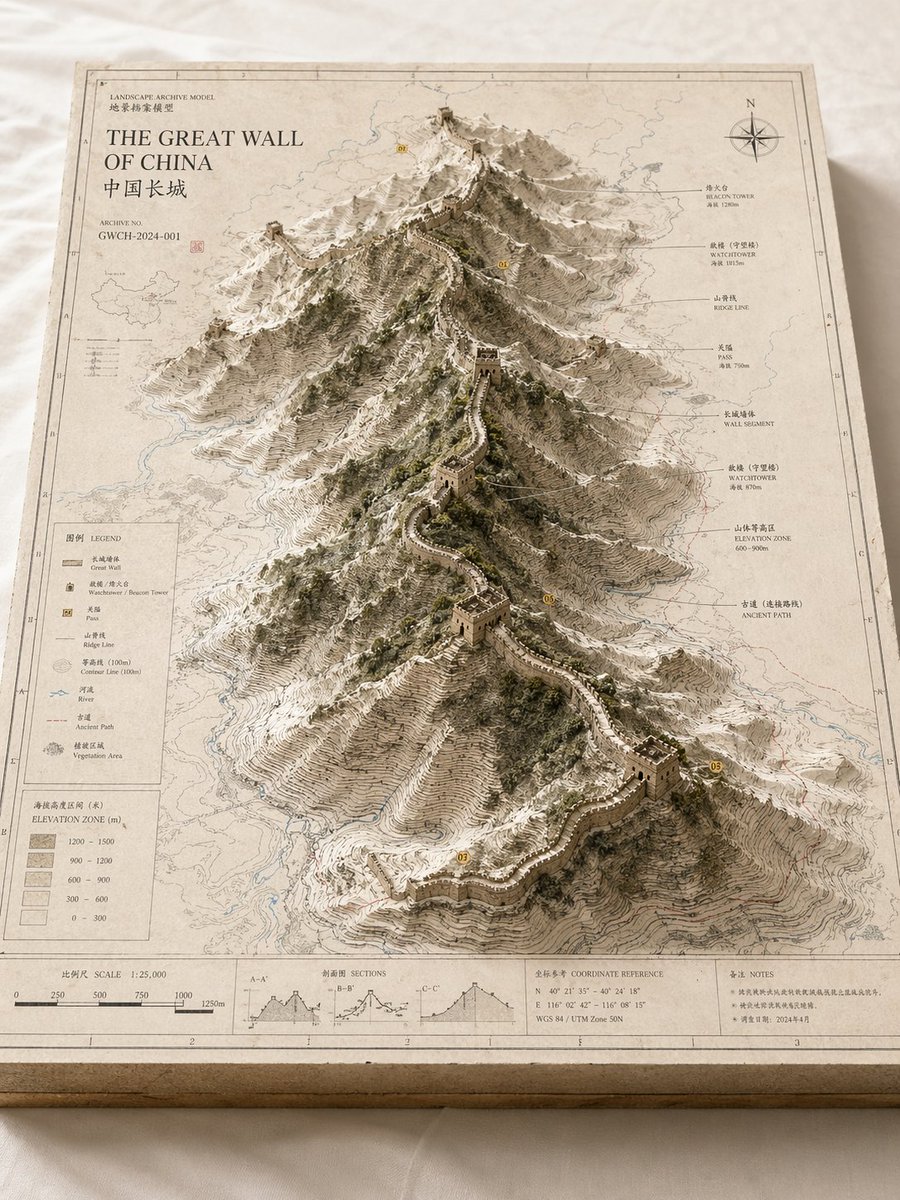
Based on the [THEME], create a high-finish, high-quality "Landscape Archive Model" visual suitable for series-style publishing. This is not an ordinary map, nor an ordinary landscape illustration or city render, but a high-end archival visual that combines "a 2D map blueprint + a 3D volumetric regional model + a professional legend system + a museum-exhibition feel." The image should look like a real, fabricated geographic research model, an urban-planning sand table, an architectural proposal model, or a worldbuilding exhibit, with a professional, restrained, precise, tactile premium texture. [Base setup] Theme: [THEME, e.g. crater lake / Guangzhou / mountainous Chongqing / island city / ancient ruins / apocalyptic ruins / fantasy continent / game capital city] Theme type: [natural landform / urban space / mixed landscape] Core subject: [e.g. crater, canyon, mountains, lake, CBD, old town, landmark cluster, island city, ruin complex, central area] Content focus: [e.g. terrain elevation / urban landmarks / road-network structure / water-system relationships / nature-city relationship / setting showcase] Style direction: [e.g. geographic survey style, paper-cut model style, architectural proposal style, museum archive style, urban planning style, game artbook style] Main color: [e.g. cream white, light gray, parchment white, sand, snow white] Secondary color: [e.g. earth brown, rock gray, cool gray, pale blue, moss green] Accent color: [e.g. thin black lines, red routes, blue hydrographic lines, yellow numbered markers] Aspect ratio: [e.g. 16:9 horizontal / 3:4 vertical / 4:5 vertical / 1:1 square] [Image structure] The main subject is a rectangular map model board placed on a clean tabletop or white cloth. The base has real thickness, with a visible cross-section at the edges, like a refined map slice or model base. The map surface carries clear but restrained information layers, including contour lines, road networks, hydrographic lines, zone boundaries, geographic textures, a sense of coordinates, light annotations, and a blueprint border. In the center or off-center area of the map, a 3D subject model "grows" out of the 2D map in relief, becoming the visual core of the whole image. If [theme type] is natural landform: the subject may consist of mountains, canyons, craters, lakes, basins, islands, glaciers, faults, coastlines, emphasizing elevation differences, layered contour structures, rock-wall textures, and natural undulations. If [theme type] is urban space: the subject may consist of the core urban area, CBD, old-town blocks, landmark clusters, waterfront, road-network nodes, bridges, water systems, parks and green spaces, emphasizing building masses, urban recognizability, spatial layers, and planning structure. If [theme type] is mixed landscape: integrate both natural terrain and built environment, e.g. mountain city, island city, ancient ruins, apocalyptic ruins, fantasy capital, sci-fi base, so that natural landform and urban structure jointly form the core visual. [Detail requirements] - The model surface retains a map-blueprint feel and a professional information feel - Terrain areas should have contour lines, slope layers, depressions and undulation relationships - Built areas should have mass, block relationships, and clear layers - Water bodies in low-saturation pale blue - Green spaces, forests, parks, mountains in moss green or low-saturation green - Road networks, paths, traffic axes or exploration routes in thin lines, without stealing focus - Landmark buildings or key structures should be clearly recognizable - Fantasy, sci-fi or game-setting elements should retain the archival-model and blueprint display feel, rather than becoming a pure scene illustration [Legend system] The edges of the map board need complete but restrained annotation modules, including: - outer and inner frame lines - scale bar - legend area - title area - archive number - index markers - annotation labels - concise symbol explanations The text need not all be legible, but the whole must present a real, clear, precise, orderly archival typographic structure. [Composition and camera] Use an oblique top-down isometric or sand-table composition, with the camera observing the whole model board from about 30 to 45 degrees above, letting the viewer simultaneously see the map plane, the height of the 3D subject, the edge thickness, and the legend area. The visual weight centers on the central subject model; the reading path is: first the core subject, then the surrounding terrain/road network/water system/block information, and finally the legend, scale bar, and annotation area. [Material and lighting] The whole needs a realistic model-photography texture: - paper texture - map-printing texture - paper-cut or sand-table model feel - architectural-model or terrain-slice texture - soft natural light - delicate realistic shadows - clean background - low saturation, premium, restrained Avoid cartoonish looks, cheap game-UI feel, excessive clutter, or over-showy technique, highlighting the unified visual of "map base + 3D subject + professional legend system." The final effect should look like a Landscape Archive Model image usable for geographic science popularization, urban research, architectural proposals, cultural-tourism visual features, worldbuilding artbooks, or high-end series covers.