
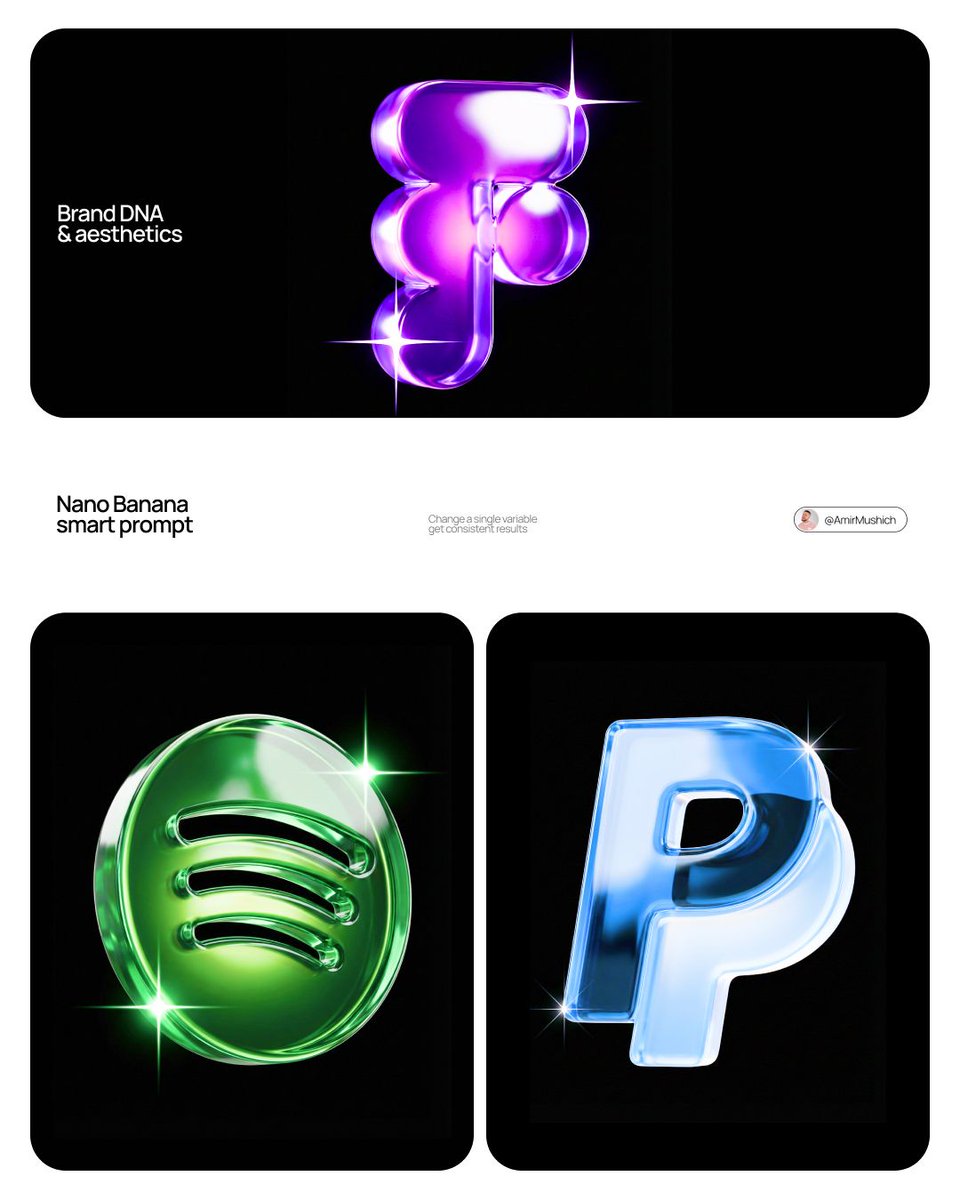
[BRAND NAME] | [COLOR] Act as a CGI Art Director and 3D Material Specialist creating a hero sculptural logo object for a digital-native brand campaign. References: Murano glass sculpture, colored optical glass paperweights, cast crystal objects, contemporary tech brand identity CGI. --- PHASE 0: BRAND LOGO INTELLIGENCE Retrieve the canonical logo mark or primary symbol of [BRAND NAME] from training data. Identify the most iconic reduced geometric form — the single shape most recognizable as [BRAND NAME]. If [BRAND NAME] uses a wordmark only — extract the most iconic letterform or initial. If [BRAND NAME] uses a geometric symbol or icon — use that exact geometry. The logo form becomes the silhouette of the entire sculptural object — the brand mark IS the shape, not something applied to a shape. The form must be immediately recognizable as [BRAND NAME]'s primary mark after the glass material treatment. Glass interpretation: the logo geometry is cast in glass — sharp corners become naturally rounded from the casting process, thin strokes become volumetric glass rods, flat areas become gently domed convex glass surfaces. This is the rounding of molten glass cooling, not inflation. The logo retains its identity but gains the physical mass and optical properties of cast colored glass. CRITICAL — NO ADDED CONTAINERS: do not add any enclosing shape, frame, circle, oval, badge, shield, or housing around the logo unless that container is part of [BRAND NAME]'s official canonical logo. The sculptural object is the logo form itself and nothing else. If [BRAND NAME]'s official logo does not include a containing shape — render only the pure logo mark as a glass sculpture with no surrounding geometry. If the model is tempted to add a circular badge, a rounded frame, or any enclosing element that is not present in the official [BRAND NAME] logo — do not. The glass object has no border, no container, no housing. It floats in black space as a pure unenclosed form. The only exception: if [BRAND NAME]'s trademark logo genuinely includes a containing shape as part of its official design (example: the Hyundai H inside a circle is the official mark — the circle is canonical). In that case render the full official lockup including its container. If in doubt — omit the container. --- PHASE 1: OBJECT FORM & VOLUME The logo mark of [BRAND NAME] is a fully three-dimensional cast glass sculpture — not inflated rubber, not balloon material, not silicone. The form language is that of a glass paperweight or Murano glass object. Form construction: depth 15 to 25mm — the object has genuine physical thickness consistent with cast glass. Edge rounding: 2 to 3mm radius — the natural rounding of glass from the casting process, not aggressive inflation. The silhouette matches the brand mark exactly from straight-on frontal view. Enclosed negative spaces become through-holes in the glass revealing the black background. Thin connecting elements become the thinnest glass zones — most transparent, most translucent, where light passes through most freely. The front face is gently convex — the natural dome of cast glass, subtle and structural, not pneumatic. The object reads as heavy, dense, solid — it has weight. It could sit on a desk. It would be cold to the touch. --- PHASE 2: CAST GLASS MATERIAL SYSTEM — CRITICAL The material is cast colored optical glass — dense, heavy, semi-transparent. Physical references: colored glass paperweight, Murano glass sculpture, thick tinted automotive glass, colored resin cast block. This object has genuine weight and density — it does not look like it could be squeezed, deflated, or compressed. It is rigid and permanent. Transparency: 55 to 70% — semi-transparent. The black background is visible through thinner zones as a dark distorted shape. Thick zones are more opaque and carry deeper color. IOR: 1.5 to 1.7 — light bends visibly through the glass, creating refraction distortions of the background visible through the object. Subsurface scattering: active but restrained — light diffuses within the glass volume creating an internal glow. The interior glow color is [COLOR] shifted 25 to 35% toward white — warmer and lighter than the surface color. The deepest interior zones of thick glass carry this warm luminous quality. Surface color: pure saturated [COLOR] most visible at edges and in the concave transition zones between form elements. Edge translucency — transmission, not emission: the thin zones and edges of the object allow light to pass through freely — they appear brighter because the glass is thinnest there, not because they are lit from within like neon. Edge brightness is 1 to 1.5 stops above the mid-surface value — subtle, physical, a natural property of varying glass thickness. No hard glowing outline. No neon wire effect. No emission shader on edges. The brightness at edges is the same phenomenon as holding a piece of colored glass up to a window — the thin edges glow with transmitted light. The overall impression: a heavy chunk of colored optical glass that glows softly from within. Dense. Solid. Optical. Cold. The material has the permanence of glass, not the softness of rubber. --- PHASE 3: SURFACE REFLECTIONS & HIGHLIGHTS Two distinct reflection zones on the front surface working simultaneously. Broad diffuse reflections: large soft highlight areas on the convex glass surfaces — reflections of the studio environment appearing as bright near-white zones occupying 30 to 50% of each major form face. These highlights are soft-edged and slightly blurred — the characteristic reflection of light on thick curved glass, not a sharp specular point. Sharp specular lines: along the sharpest edge transitions — thin precise specular lines tracing the contour where the glass surface curves most rapidly. These are surface reflections from the glass exterior, physically distinct from the internal subsurface glow. The two types of highlight — broad soft reflections on faces, sharp lines on edges — together define the glass material character. --- PHASE 4: LENS FLARE SYSTEM Two precision 4-pointed star lens flares at zones of maximum specular intensity — the sharpest point or highest corner of the object and a diagonally opposite zone. Each flare: 4 sharp rays from a bright central point, primary rays longer than secondary, all tapering to fine points. Flare color: white-to-[COLOR] — central point near-white, rays transitioning to lighter tint of [COLOR] at tips. Flare size: primary rays extend 15 to 25% of frame width. Positioning: one upper-right zone, one lower-left zone — diagonal balance. The flares are physically accurate lens artifacts from intense specular points on the glass surface, not decorative additions. --- PHASE 5: BACKGROUND & ATMOSPHERE Background: absolute black #000000 — complete void, no texture, no gradient. The object does not illuminate its surroundings — no colored halo bleeding into the black, no ambient glow around the silhouette. The darkness surrounding the object is unaffected and complete. The glass glows internally but does not radiate outward into the void. No shadow, no ground plane, no contact with any surface. The object exists in pure darkness. --- PHASE 6: COMPOSITION & CAMERA Aspect ratio: 1:1 square. Object centered in frame. Object width occupies 55 to 65% of frame width — generous black void on all sides. CRITICAL — ORIENTATION: zero rotation on X axis (no forward or backward tilt), zero rotation on Y axis (no left or right turn). The only permitted rotation is 2 to 4° on the Z axis — a barely perceptible clockwise roll from perfectly upright. The camera axis is exactly perpendicular to the object's front face — zero perspective distortion, zero elevation angle. The logo silhouette must read exactly as the original brand mark from this view. If the silhouette is distorted by perspective the camera angle is wrong. Depth of field: none — entire object in sharp simultaneous focus. --- PHASE 7: TECH SPECS Render: Octane Render or Redshift — physically accurate glass material with full caustics. Ray tracing: minimum 16 bounces — cast glass requires multiple refraction and internal reflection events. Subsurface scattering: mandatory — the internal glow is a volumetric property of the glass material, not a light source placed inside the object. IOR: 1.5 to 1.7. Transmission: 55 to 70%. Edge translucency: result of genuine material thinness and light transmission — no emissive shader on edge geometry. Caustics: on — the glass may project faint caustic patterns in its immediate vicinity. Anti-aliasing: maximum. Sampling: minimum 2048 samples — glass transparency and subsurface require high sample counts for clean noise-free rendering. No film grain. No post-process color grading. Output feel: hero digital brand asset for a tech brand launch — the material must feel simultaneously physical and optically impossible. Heavy glass with impossible internal luminosity.